Showing posts with label transportation. Show all posts

Making the walk walkable

A few summers back, I was an unpaid intern at the City of Spokane. The fact that I was unpaid is not of great concern to me (it did, in the end, work out quite handsomely for me) but, it did provide me with a specific motivation: attempt to avoid any costs whatsoever in the performance of my work. I labored on a number of projects while I was there, and I could regale you with stories about federal grant application or the design of local economic development strategies, but this post is more pedestrian.

I'm fond of saying that the purpose of transportation systems is to bring your destination within walking distance. While that is useful in pointing out that no car, bus, train, bike or other transportation mode is necessary if you're within walking distance, it also raises the question, "what is walking distance?" This is an important question because the design of effective walkable districts is dependent on understanding the willingness and capability of pedestrians to utilize it.

While different pedestrians have variations in ability, I'm not going to dwell on that issue for this particular entry. However, I will briefly state that the Americans with Disabilities Act (ADA) has the potential to greatly enhance the ability of people to have access to the world around them without significantly disadvantaging anyone. The minimal costs associated with ADA compliance is trivial compared to the sums lavished on roads and highways. Whenever I say "pedestrian" in this entry, please remember that it's not just people in sneakers, but also people in chairs and with strollers and other devices who use many of these same facilities and deserve the same level of access.

Making it Walkable

Pedestrians need more than a strip of concrete to make the walk walkable. Yes, the distance is key and that implies density. Ultimately, density is determined by the private sector in response to travel patterns and availability of investment. However, there are public decisions which can greatly enhance the walk, and perhaps influence private decision-making.

Shortcuts. One of the reasons we use vehicles for travel is to make ourselves less sensitive to the distances involved. It stands to reason, then, that pedestrians are less likely to walk if they have to go far out of their way to reach their destination. For my internship, I took a shortcut through a park. Pedestrians are more flexible with their courses than cars because it takes far less space and infrastructure to support a pedestrian route than it does for an automobile route. Creating shortcuts can provide great advantages for relatively small costs.

Plenty of destinations. Just because a person is busy walking to a final destination doesn't mean that the final destination is the only destination! Having the ability to combine trips is a powerful incentive to coax reticent walkers to ditch their cars. You may expect that I would introduce you to several studies which emphasize this point, but rather than do that, I will just mention one thing: shopping malls. The entire theory behind shopping malls is the power of combining trips, and the success of a well-managed mall is a testament to this concept.

Presumptive signalling. I can't emphasize this enough: waiting for a cross signal greatly slows an already slow travel method, and requiring a pedestrian to push a button mandates the wait. The signals should be set to allow enough time for a pedestrian to cross without prompting from pressing a button, thereby eliminating the need for the button. If the light changes automatically for automobiles, then the signal should allow a pedestrian to cross as well. If the signal isn't normally long enough for a pedestrian to cross then the signal may cycling too quickly or the cross street may need to go on a diet.

Alternatives. If there are multiple routes to a destination, then no single barrier or hazard can prevent the trip from occurring. Having alternatives also goes especially well with presumptive signalling by allowing the pedestrian to take advantage of the cross signal no matter which one is active. It also provides a greater opportunity to engage an interactive, varying environment.

Interactive environment. Pedestrians experience their environment in much greater detail than auto drivers. This not only gives the adjacent property owners an excellent opportunity to interact with the pedestrians, but it also levies a minor obligation as well. If a walking area is boring, then the pedestrian will avoid it for more interesting areas. And when people aren't attracted to a place and occupy it, then a place may not maintain a positive reputation.

Safety, cleanliness. This is fundamental: the trip must be reliably safe. Unclear sidewalks, overhanging branches, uneven surfaces, and anything that reduces the visibility of pedestrians in an auto-dominated environment are serious barriers to pedestrian activity. Cleanliness is a standard by which the safety of a path is judged, so walkways must also be well maintained.

Refuges. Providing pedestrian amenities to manage the effects of fatigue and weather are useful as well. Awnings, besides being useful for site identification, are attractive for pedestrians who wish to avoid sun or rain. Benches provide an opportunity to rest and interact. There is also the technical pedestrian refuge: a space in the median of a road where a pedestrian can stop so they only have to cross half the traffic at one time.

Human services. In addition to managing the negatives of pedestrian activity, it's helpful to have some services available to be provided directly to the pedestrian, such as meals, coffee, etc. Not only does this enhance an area for the pedestrians, it also provides people with an excuse to become pedestrians for the adjacent properties. One of the first thing we noticed as students surveying Sprague Avenue in the University District was that there's the smell of coffee from a local roaster, but no coffee retail. Without this amenity, there's really no way for people to gather and produce a community.

Friendliness. And another part of making that community is having a culture that appreciates the presence of other people. I was struck one morning, heading to City Hall, by the great attitude of another downtown employee. He was wearing a "Cruisers" (a local burger joint) shirt, asking how I was doing that day. We weren't at his place of work--he was just being friendly to a fellow pedestrian. When I told him that I was impressed he said he was "just making Spokane a great place!" True.

Four the Future - Reconfiguring Roads

A look at the issues surrounding road reconfiguration: the redesign on Spokane's Community Block, an adjacent neighborhood's opposition to a pedestrian mall proposal, the massively positive effect of roads on retail activity, and a peek in on a little-used alternative.
  • Getting There: West Main to get new kind of street parking
    Source: Spokesman-Review; September 5, 2016
    Summary: Main Avenue between Division and Browne will be reconfigured to add additional parking and pedestrian amenities. The street will be reduced to two lanes in order to accommodate a third lane of parking in the median, a mid-block crossing for pedestrians with channeling structures that create pedestrian havens, and pedestrian-scale lighting. Local business owners are in favor of the new design.
    Opinion: The new design is highly supportive of the activities on the block in question. It will take some time for drivers to adjust to the new configuration, particularly since traffic speeds is likely to reduce. And, of course, there will be the routine scoffing from the peanut gallery (as always, it's important to remember not to enter the cesspool that is the comments section of the Spokesman-Review website). However, with greater parking and pedestrian support, the retailers should benefit.
  • Rose Pak flashes red light on Stockton Street pedestrian mall
    Source: San Francisco Chronicle; August 7, 2016
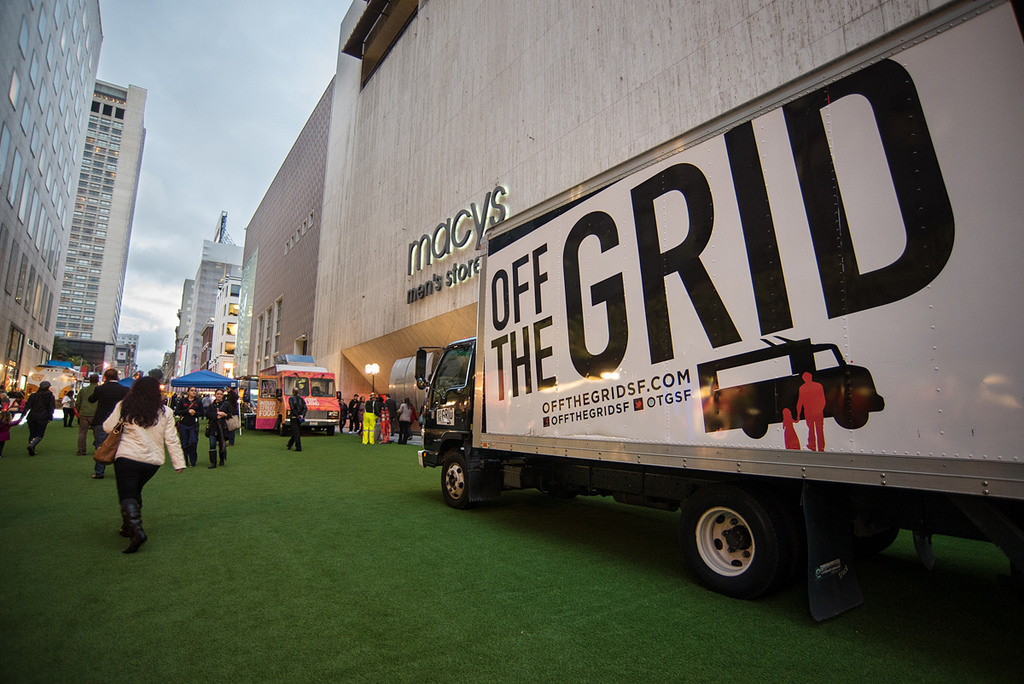
    Summary: When San Francisco tore up Stockton Street to install a subway, the businesses of the Union Square Business Improvement District suffered sales losses (this is a misinterpretation of the data; more on that below). The solution was provide the retailers with a pedestrian area with artificial turf (here is a photo on the installation, provided by the San Francisco Metropolitan Transportation Agency):

    Photo of artificial turf mall, courtesy of San Francisco Metropolitan Transportation Agency

    This sparked the idea of making a permanent pedestrian mall. However, the adjacent neighborhood is registering an objection because they want the road to be available to bring traffic to their businesses.
    Opinion: This demonstrates a fundamental issue in transportation planing in the United States: for whom is the right-of-way designed? The reason why we have this problem is that Americans tend not to differentiate between roads (which are used to increase mobility and provide a path through a place) and streets (which are used to increase access and provide a path to a place. Instead, we design and construct stroads, which do neither task particularly well, and are dangerous to boot. We know instinctively that we do this incorrectly: just think of the number of times you've complained about people driving too fast through your neighborhood. People drive fast on roads and buy things (and live) on streets. Planners need to get property owners to collaborate on what their right-of-way is intended to achieve, and transportation engineers must design to those purposes.
  • Getting There: Downtown Spokane businesses suffer in construction zones
    Source: Spokesman-Review; August 15, 2016
    Summary: Businesses adjacent to construction projects in Spokane depend on revenues from people to travel to their locations. But, when construction occurs, customer visits drop (in one case, by half) imperiling the business. Other businesses are less affected because they have a dedicated customer base. Extending construction hours to reduce the length of time isn't effective because it would cost more and the work is job is hard on the workers.
    Opinion:Americans are strongly driven by convenience. If the journey to your door isn't convenient, it just isn't taken. Unless you're an anchor (or "destination") retailer, ease of access is key--and that's exactly what government-maintained right-of-ways are providing. I humbly suggest that, rather than take this story as a tale of woe about construction barriers, please view this as a testimonial as to the effectiveness of the roads all the other summers when construction isn't at your doorstep. Yes, it hurts this year, and help would be beneficial, but remember that the road doubles your sales all other years.

    This story has been updated.

  • Omaha's answer to pothole complaints: a new dirt road
    Source: Associated Press; August 16, 2016
    Summary: To the chagrin of its residents, the City of Omaha is removing pavement in certain neighborhoods. All cities have a long list of deferred road replacement projects, but Omaha is characterized by extreme sprawl. Making short-term deals in order to encourage development results in these long-term deficiencies.
    Opinion: The chickens come home to roost. Of course, the initial developers want to avoid costs in order to make their developments more profitable and avoiding building to City standards is one way to do that. Of course, that means that the neighborhood has a responsibility to maintain the road, but they rarely do because, again, they're trying to avoid paying for what they're using. I hasten to add, though, that we shouldn't dismiss the possibility that the City demands that everyone have a stroad in front of their house rather than a street! Regardless, the costs of periodic repavement is substantial, and many people are satisfied with letting some (read: someone else's) neighborhoods degrade. It's high time that the federal and state governments deny funding for and authority to accept new road construction without demonstrating that they have the funds available to properly maintain their road infrastructure.

A Developer's Perspective

9:09 AM: Presentation by Jason Wheaton, President, Greenstone Corporation

9:11 AM: Jason came from California, which he likes, but this area is paradise. They consider themselves as a communication company rather than a developer. When things go wrong it may be because they failed to communicate well with their internal and external customers. They tell themselves that 30% of everything they're doing is wrong. It's a hard thing to say. If you have the attitude that 30% of what you're doing is wrong, you can always get better. 30% of environmental regulations can be better, too.

9:15 AM: Market Conditions...job growth and interest rates will be the driving force in the recovery. With efforts to reduce the deficit loom, the effect on local and regional governments should be monitored. Vacancy rates are leveling off. There are opportunities, and there is some optimism.

9:17 AM: Housing inventory is beginning to be depleted. California still has a great deal of inventory. We're in a better situation. But, our market is fragile. They closely monitor the Spokane MLS Quintile Analysis. Greenstone tries to serve the middle three quintiles. There's little margin at that level for brownfield remediation.

9:21 AM: Spokane is a relatively affordable market for nice housing. The community is "tremendously appealing." With the medical base, there's good economic prospects. There are existing opportunities as demographics change. The current housing mix isn't good for our future demographics. "Investment Capital is very difficult to attract." Money is currently going to markets which were hardest hit. Spokane isn't in that category.

9:25 AM: Greenstone has adjusted to the new market, bringing down their labor force by 25%. "Hope is not a strategy." Buyers are purchasing homes for shelter, not investment.

9:26 AM: How does out region manage growth. Greenstone is pursuing a "Sustainable Growth Model." "We need strong urban growth in the next 20 years." The baby boomers are aging and are looking for a different kind of lifestyle. Empty nesters will increase by 244%. "This will be a huge burden on our government."

9:29 AM: We spend about 32% of our income on housing, and 17% on car ownership. That's 49%. If we can develop lands to reduce auto dependency, then more can go to housing and less to cars. "Shelter isn't going to be less expensive." Health care is getting more expensive. What's happening is that discretionary expenses are going away: entertainment, clothing, household furnishing, education, pensions and social security contributions. It's an attack on what made the middle class feel prosperous.

9:35 AM: Municipal infrastructure is crumbling, and it will be expensive to repair. $21.8 billion annual need for over 20 years just for transit. $131.7 billion and $9.4 billion annually for deficient roads and bridges. Water will be $151 and wastewater will be $390 billion.

9:37 AM: Only 10% of the growth is occurring in the areas which are designated as centers and corridors. Development is happening in the wrong places. There are several incentives to encourage development in the right places, but it's not happening. The brownfields in Spokane are so intense, the original map was impossible to read. There are significant areas which cannot be utilized because of this. You can follow the rail line through town on the brownfields map.

9:39 AM: Jason recommends very strongly the Department of Ecology's "Guide to Leveraging Brownfield Redevelopment for Community Revitalization." (Publication number 10-09-054.) He read the full first page of the document.

9:41 AM: There are benefits to brownfield development: creating jobs, leveraging existing infrastructure, neighborhood revitalization, new local revenue and taxes, clean up environmental problems, reduce urban decay. "Neighborhoods are always getting better or getting worse."

9:43 AM: Developers need information about the land in order to create economic certainty. Financial institutions resist investment due to "perceived long term liability and marketability issues." Brownfields depress land values, this prevents investment for remediation, so it perpetuates the problem. Most of the brownfield projects are downtown because land values are higher. This is highly inelastic, small price changes eliminates the ability to build. Worse, it affects adjacent properties' value that discourages continued investment.

9:48 AM: A review of Kendall Yards and its changing ownership. Had to leave to prepare for next section, entitled Q&A with the Deal Makers.

Transportation and Public Health Survey

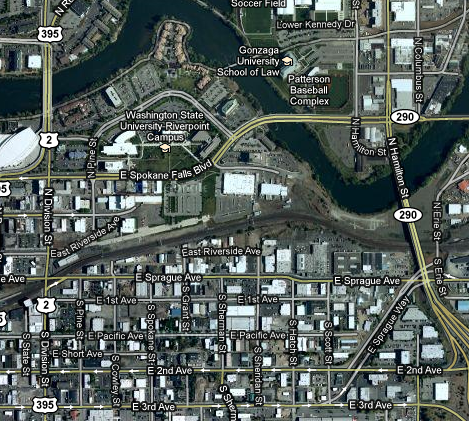
Yesterday, a group of volunteers and I worked for a couple hours for the Spokane Regional Health District surveying residents in the northwest corner of the East Central neighborhood and observing the physical conditions of their neighborhood. Survey AreaThis area (south of the Spokane River, east of Division, north of 2nd Avenue, and west of Sprague Way and the Hamilton overpass) is part of Spokane's University District. The effort was conducted to survey the residents' attitudes about the proposed pedestrian overpass between the Riverpoint Campus and the warehouse district. But, additionally, the survey's observations can serve as a baseline for any changes that occur due to investments made in the area. That is, we're taking the "before" picture. The results will be used to help inform the health district in their recommendation to the City of Spokane.

Wondering why this is being conducted by the Health District? The Health District has a Physical Activity and Nutrition program which, in part, encourages pedestrian and biking activity. The Health District is performing this research in order to estimate what kind of change in physical activity is likely to occur as a result in a change in the pedestrian infrastructure.

There was only about a dozen of us, but we did survey the entire area in just a couple hours. I was working with Mohammed Aly, another graduate student in the urban and regional planning department at EWU. The area we were assigned was the southeastern portion, mostly auto-oriented businesses, self-storage, some office spaces, and, from what we noted, one residence. We walked up and down the streets wearing orange vests assessing the prevalence of vandalism in the area, including graffiti and broken windows.

I think there's something very useful in having people actually take a look at their environment. It's difficult to change something unless you take the time to truly take a look at it. What I would have enjoyed in addition to this is to go with one of the residents and business owners (or more) to allow them to point out what they think is important. We did meet a gentleman there who certainly seemed engaged and willing to share his community with us, and I suspect it's not any different in many other places, too. In an ideal planning activity, you'd want to include that kind of data to ensure that you're not trying to solve a problem that doesn't exist in the minds of the people who are involved.

It was an excellent experience, one I'm looking forward to repeating, especially if the weather is as nice as it was yesterday!

For more information on the pedestrian bridge, and many other transportation- and transit-related projects in the downtown area, you are invited to an open house from 4:30 PM to 7 PM on Tuesday, March 29, at the Spokane City Council Chambers on the lower level of Spokane City Hall, 808 W Spokane Falls Blvd.

Separated Bike Lanes

One topic often addressed by this blog is that of bike lanes due to their importance in creating complete streets to increase transportation choices, improve air quality, and decrease our dependence on oil. But, it also gets significant attention here because it is the subject of significant controversy.

One of the ways that a safe, welcoming bike lane can be provided to the public is by separating the bike path from the auto lanes. (Want to see the study on separated bike lane safety? Here it is from Injury Prevention.) These separated bike lanes not only make clear the place where bicycle riders are to be, but also exclude dangerous elements, such as moving automobiles or stationary ones with their doors suddenly opening in the path of a biker ("dooring"). And, yes, it does happen, and it can be fatal.

Spokane has a separated bike trail: the Centennial Trail. However, that's more of a bicycle highway, which allows people to travel long distances undisturbed, but also fails to successfully deliver bike riders to their destinations without, as Danish architect and infrastructure consultant Jan Gehl says, "[letting] people fend for themselves once they reach the city." Nevertheless, it's a commendable achievement that we should build upon.

The true usefulness of separated bike paths is when they're permitted to enter the core of the community. A local example of that is the bike system in Liberty Lake. It connects to the Centennial Trail, consists of a number of interconnected trails (though, not all are separated from the road), and many are surrounded by trees and grass. But, these are not urban trails as would be necessary in downtown Spokane or anywhere else where they'd need to be shoehorned in. So what do we do in that situation?

Well, it's pretty congested in New York City:


The first separated bike lane in NYC was proposed in 2007, and its cross-section is below. In this case, a 15-foot wide planted area was inserted into the right-of-way to come between the moving automobiles and the bicyclists. The planted area also includes parking while protecting the bikers from being doored.


The video above did note that there are places where solid barriers would be inappropriate, such as when emergency or delivery vehicles must approach the curb. In that case, a double rolled-curb barrier such as the one displayed here (thank you to StreetsWiki) could be more appropriate. Other options mentioned in the video include bollards (removable vertical poles) such as the ones you see where the Centennial Trail crosses roads. They prevent vehicles from passing, unless you have the authority that comes along with having the key.

Coming back to the Pacific Northwest, the current issue of Planning Magazine brings the story of Vancouver, British Columbia's newest experiment in separated bike paths. While separated bike paths were available along the water's edge, last summer brought a proposal to separate the bike path on Hornby Street, penetrating into downtown.

Could Spokane do the same thing? It does present challenges. It is more complex than laying down stripes and it does need to be designed into the physicality of the road. Second Avenue, for instance, would need a concrete strip of some kind in order to move the parking meters away from the sidewalk. However, for much of Spokane region, the roads are very wide, and a few feet for a concrete strip would be easy to accommodate. Plowing would become impossible in the bike lanes in that case, but the city doesn't sufficiently maintain the bike lanes in those situations, anyway. Indeed, you might be able to pitch it as an alternative to piling up snow in the middle of the road during major storms.

As always, the character of the neighborhood and the people's transportation demands will be key to deciding what form a transportation asset will take. But, no matter what you may think about them in general, building separated bike lanes is a valid alternative, and no transportation plan proposal should be presented to the public without it.

Four the Future - SARP

The Sprague/Appleway Revitalization Plan (SARP). For those who are unfamiliar with it, SARP is a plan adopted by the Spokane Valley City Council. There were several controversial aspects to it, including "down-zoning" areas along Sprague Avenue east of the Sprague/Appleway couplet, and converting Sprague back to two-way traffic. Several of the city councilmembers who supported the SARP were turned out of office in the following election by a group calling themselves the "Positive Change" coalition.
  • SARP Opposition
    Summary: At the west end of the SARP area, officially called the Gateway Commercial Avenue and Gateway Commercial Center zones, the rules for mixed-use development were changed by the "Positive Changes" coalition to allow Harlan Douglass and Elephant Boys operate an auto-sales business. This amendment occurred after Douglass had sued the city, but the city successfully defended the original denial. The planning commission had recommended that wall signs be banned above the first floor. Councilmember Rose Dempsey indicated support for that recommendation, but Councilmember Dean Grafos "abruptly shut down discussion" (Spokesman-Review, "Ordinance allows vehicle sales in mixed-use avenue zone", September 16, 2010) and the council overturned the commission's recommendation. A month later, in a 5-2 vote, the City Council voted to kill SARP with Bill Gothmann and Rose Dempsey in opposition. Gothmann argued that some plan needs to be in place, even if it's not SARP. Councilmember Bob McCaslin argued that there is a plan: private enterprise. Carlos Landa, who owns a strip mall that is 80% vacant at the corner of Sprague and Pines, said that he won't commit to invest $250,000 in improvements without a plan to revitalize the corridor.
    Opinion: The advantage of planning is that people can make commitments with the confidence that the plan will be executed. In other words, plans reduce risk and that encourages investment. In a wider context, the problem is more than mixed use area codes and down zoning, etc.:
    • Spokane Valley is totally lacking in identity, so they can't leverage that into a vision for the future. The absence of neighborhood councils contribute to this problem.
    • Spokane Valley is the definition of sprawl, with far more authority to develop than the economy could possibly support. As a result there is no guidance as to where people should invest in the community. It used to be that transportation and communications were limitations where a person would develop. But, with Spokane Valley's history of indiscriminate public "improvements," the aphorism "location, location, location" means nothing and Bob McCaslin's misguided denial of responsibility all the more disappointing.
  • Commission won't back zoning change
    Source: Spokesman-Review; December 16, 2010
    Summary: The new Spokane Valley City Council wanted a change to the comprehensive plan to allow an automobile dealership in the area the previous city council wanted to more walkable, more densely built city center. The city council declared an emergency declaration to change the plan out of cycle, and sent the change to the planning commission. The planning commission, however, did not see that there was an emergency and voted against the amendment.
    Opinion: The commission was responding to the changes the City Council requested on behalf of Pring Corporation between Sprague and Appleway on Dartmouth. One of the commissioners stated that they existed in order to assist the city council, and should consider the council’s recommendation. Another observed that they should not just rubberstamp everything. The second is correct. Congratulations to the Spokane Valley Planning Commission on having a backbone. Too bad the council will likely ignore them. Clearly, the city council has no idea what an "emergency" actually is. It's not a convenience for political considerations, but used for the adoption of regulations to protect the public health, safety, and general welfare.
  • Couplet likely to remain
    Source: Spokesman-Review; October 30, 2010
    Summary: While the Spokane Valley City Council has begun the process of discarding SARP, one of its elements, converting Sprague back to a two-way street, is still on the table. Except, there's no money. It would cost $1 million to restripe and change stop lights. Additionally, it would cost millions more if landscaping other tweaks are included. Mayor Towey believes that it will take 9 to 12 years to gather the funds to do such a thing. Business owners in the SARP area, pedestrians, and the fire district are opposed to the couplet, while many drivers prefer the wide open driving experience.
    Opinion: The article didn't mention the possibility that the state would force the City of Spokane Valley to repay the millions of dollars the state gave in grants to reconfigure Sprague in the first place. Spokane County engaged in some shenanigans to get that money in the first place, bypassing the Spokane Regional Transportation Council and spending money not authorized by the regional plan, so the other local governments will be less than excited to spend even more regional dollars on authorizing the change anyway.
  • Emergency ordinance Jan. 11 would bury vision of SARP
    Source: Spokesman-Review; January 1, 2011
    Summary: With apologies to Shakespeare, City Councilmember Rose Dempsey adapts Mark Antony’s oration at Julius Caesar’s funeral ("Friends, Romans, countrymen, lend me your ears") to plead for public involvement in the upcoming hearing regarding SARP’s fate. She points out that recently deceased King Cole had a vision for the City of Spokane, and great things happened. She says that disposing of SARP, which is intended to encourage the economy of a low-performing area of the city, is happening merely for the advantage of one person (presumably Pring).
    Opinion: In choosing Mark Antony’s speech to imitate, Councilmember Dempsey not only appears to supporting the SARP as a platform from which a reasonable plan can emerge, but also appears to be encouraging people to question the honor of the "Positive Change" coalition. After all, how many times can one person say that the "council is honorable and just" without others considering whether it is true or not? This is no mean disagreement. These are people fighting over the plan, and it has become highly political as important plans tend to become. But, it has also become personal, which is simply embarrassing.

Four the Future - Air Quality

Four air quality articles, including an update to the Waste-to-energy mercury violation, power plants killing plant life, smoking-related deaths, and improvements in a world city's air.
  • City, air agency could settle fine, upgrade incinerator
    Source: Spokesman-Review; December 28, 2010
    See also: Four the Future – November 3
    Summary: The Spokane Regional Clean Air Agency has offered to settle a Waste-to-Energy air quality violation from last year for $5,000 and a required upgrade. During a test, the City of Spokane turned off a pollution control system they normally use to prove they didn’t need it. Under the deal, a carbon-based system will be installed at a cost of approximately $40,000. The director of the Spokane Regional Solid waste System says the cost won’t make much difference because the plant was already committed to using the new system.
    Opinion: The attitude that argues that air quality control measures are unnecessary might stem from a philosophy of maintaining flexibility or being scientific in their approach, and not merely to thumb their noses at regulators. Indeed, the former what the city is claiming. Latest update: the city agreed.
  • Is coal-fired power plant killing farmers' trees?
    Source: MSNBC; December 28, 2010
    Summary: Farmers in central Texas are losing their crops, they say, because of the sulfur dioxide emitted by coal-fired plants. Sulfur dioxide, combined with water, makes sulfuric acid, a source of acid rain. It is known that sulfur dioxide kills trees, especially pecan trees. The Fayette Power Project has operated for 30 years, mostly without emissions control. The Lower Colorado River Authority, which operates the plant, and the state regulator both say it is not the plant's fault, but the EPA is suing Texas over its failure to enforce the Clean Air Act. There are 19 coal-fired plants in Texas. Each place where the trees are dying off there is a plant nearby. The EPA’s criminal investigation branch is getting involved. In the meantime, the Fayette plant is receiving a $500 million upgrade to scrub sulfur.
    Opinion: This is one of the difficulties with coal, other than coal not being renewable and its combustion causing climate change. Coal contains about 1% sulfur. Lower quality coal (which is what is used because much of the high-quality anthracite has already been burned) has more sulfur.
  • More Than 600,000 People Killed by 2nd-Hand Smoke
    Source: ABC News; November 26, 2010
    Summary: Annually, passive smoking causes about 379,000 deaths from heart disease, 165,000 from lung disease, 36,900 from asthma, and 21,400 from lung cancer. This accounts for about 1 percent of all deaths. This is in addition to the 5.1 million deaths caused by smoking. Children are especially affected due to SIDS, ear infections, pneumonia, bronchitis, and asthma.
    Opinion: If smokers as a group killed 600,000 non-smokers a year by any other means, it would be called murder. Hopefully legislation such as the Washington Clean Indoor Air Act will show a reduction in deaths over time. However, since it doesn’t apply to homes, children will still be disproportionately harmed.
  • What's missing in Mexico City? Dirty air
    Source: McClatchy; December 2, 2010
    Summary: In 1991, Mexico City’s air had only 8 days with air quality below hazardous levels. This year, however, adequate to good air days has set a record of 193 days. This is a result of policies such as emissions testing every six months, reductions in lead and sulfur in fuels, and the relocation of the heaviest polluting factories. In 1989, the city created Hoy No Circula ("No Driving Today") that prevents driving one day per week. They also expanded the subway system and extended bus-only lanes for low-emission articulated buses. Still, ozone is a problem 180 days per year, complicated by the city’s high altitude.
    Opinion: Mexico City is an mega-huge, sprawling city. Just like Los Angeles, it is heavily auto-dependent. And like Los Angeles, they have air quality issues and are embracing infrastructure-intensive transit as a solution. Smaller cities would be smart to heed the lesson and avoid the auto-centric, sprawling pattern that made those cities so dirty.

Four the Future - November 3

Today: helping you breathe easier.
  • New U.S. Standards Take Aim at Truck Emissions and Fuel Economy
    Source: New York Times; October 25, 2010
    Summary: The Obama administration is proposing new fuel efficiency rules for heavy vehicles, mainly "tractor-trailers, buses, delivery vans, heavy pickup trucks, [and] cement mixers" for vehicles manufactured between 2014 and 2018. Changes are intended to reduce fuel consumption by 10 to 20 percent, depending on type. A recent study showed that fuel consumption could be reduced by up to 50 percent.


    Opinion: The study cited above states that for the cost of $84,600 per tractor-trailer, fuel efficiency could be doubled, offering a return on investment of 10% as long as fuel was at least $1.10 per gallon. As of October 25, the cost of diesel fuel is $3.067 per gallon, up $0.266 from last year, which means the ROI would be much higher.
  • Mercury emissions too high during incinerator test
    Source: Spokesman-Review; September 17, 2010
    Summary: During its annual air-quality testing, Spokane’s Waste-to-Energy plant failed its mercury emissions test. The plant has an effective "carbon pollution control system" to capture mercury prior to release, but it is turned off during testing to prove that it doesn't need it.
    Opinion: Um, apparently, it does need it.
  • Lowe’s and Wal-Mart pay multimillions in air pollution fines
    Source: Los Angeles Times; October 29, 2010
    Summary: Lowe’s will pay $2.75 million, and Wal-Mart will pay $2 million in a settlement for having sold paint that causes smog.
    Opinion: One of the important parts of the green building movement is to make the places we occupy healthier for people. One of the requirements to qualify for recognition as a green building is the use of paints and coverings that emit fewer, or no, volatile organic compounds (VOC). Consumer Reports ran an article regarding these paints last year. Standards will change over time, producing improved respiratory health, but either our expectations for paint will have to change or the coverings industry must find ways to provide their product without harming their customers.
  • Agency offers seminars on proper wood burning
    Source: Spokesman-Review; October 21, 2010
    Summary: The Spokane Regional Clean Air Agency (SRCAA) is offering seminars on how to burn wood cleanly at 11 AM to noon the next two Saturdays at three locations around the region. You may also receive more information directly from the agency with a brochure or DVD.
    Opinion: Spokane sits in a big valley that, when there’s an inversion, the air near the ground cannot escape. In that case, all the smoke emitted by fireplaces stays here in the valley. The SRCAA is responsible for enforcing burning restrictions to maintain air quality in Spokane when there’s an inversion. When people burn cleanly, it not only improves our air quality, but clean-burners get to use their wood burning appliance when dirty ones cannot.

Four the Future - October 25

This week, you have several public participation opportunities.
  • STA seeking public input on budget cut proposals
    Source: Spokesman-Review; October 4, 2010
    Summary: Spokane Transit is preparing for service cuts next September. Planning for the cuts is already underway. The cuts affect a number of areas and STA projects they will to reduce ridership by 6 percent. You can read the proposed plan and share your opinion right now.
    Opinion: The board was preparing to cut service by 40% back in 2004 when the voters of the region forced them to put a revenue enhancement on the ballot. Transit will become a more and more important part of our transportation mix in the future. It is important for us all to make sure it is there when we need it.
  • Help shape Spokane's transportation future!
    Source: Spokane Central City Transportation Alternative Analysis
    Summary: Focusing on the needs of downtown Spokane, this effort needs input to help guide the future of transit for the region. The Open House is on Tuesday, October 26 from 3:30 to 7 p.m. at Riverpoint's South Campus Facility at 412 E Spokane Falls Blvd.
    Opinion: Lots of studies have been done. This is intended to pull them together, and your input should be provided to ensure that the transit options are made available and are integrated into everyone’s planning.
  • Is The Suspense Killing You?
    Source: SRTC Transportation Blog; October 22, 2010
    Summary: The whole region is waiting with twitchy mouse fingers to play Spokane's transportation planning game. It should be available on Wednesday, October 27 at the Spokane Transportation Vision web site.
    Opinion: *twitch, twitch*
  • Change in greenhouse size limits proposed
    Source: Spokesman-Review; October 15, 2010
    Summary: Spokane County has been petitioned to allow larger commercial greenhouses on rural lands. The current limit is 20 percent of the least dense rural zones, 25 percent on Rural-5 zones, and 50 percent on rural activity center zones. The public hearing is at 9 a.m., Thursday, October 28, in the basement of the Spokane County Public Works Building at 1026 W Broadway, Spokane.
    Opinion: Really? They want rural conservation lands, the ones specifically held aside for important wildlife habitats, to be completely covered by buildings? Irrational. I don’t even understand why 20% is permitted in those areas currently. Unless the farm is actually using the ground as the growing medium, greenhouses shouldn’t be in rural areas, anyway. In that case, put them in the marginal lands currently designated for industrial purposes. After all, we have a serious oversupply of that.

Four the Future - October 4

Water in China, Chinese emissions talks, emissions standards changes, and transportation choices affect health.
  • China moving heaven and Earth to bring water to Beijing
    Source: Los Angeles Times; September 29, 2010
    Summary: China is building a series of aqueducts to bring water from the wet south to the parched north. It’s a sacred project because Mao Tse-tung mentioned the concept in 1952. In China, water naturally flows west to east, so the Yangtze River will supply water that is tunneled under the Yellow River, for instance. The Yellow, itself, cannot supply water because it's too polluted. Hundreds of thousands of people have been forced to relocate due to inundations cause by dam projects to supply the system. Entire villages are being scooped up and relocated hundreds of miles away to less productive areas, forcing them to be retrained to sow their (ironically) drier soils.
    Opinion: It's hubris, and a total lack of respect for human life, environmentally mitigated balances, and even basic rationality. It’s not your fault, but do be mindful that this is what the Chinese do with the money they get from your purchases.
  • Climate talks put top emitter China in hot seat
    Source: Los Angeles Times; October 2, 2010
    Summary: China is hosting the next round of UN talks regarding reducing greenhouse emissions. China has recently become the world’s largest greenhouse gas producer, recently surpassing the United States. There is distrust between developed and developing countries as developing countries see the developing countries emitting immense amounts of CO2 per capita, and attempting to prevent industrial development by restricting carbon emissions. The United States’ intransigence is often cited as a cause of that rift. Failure to make progress could result in the inability to renew the Kyoto protocol, which expires in 2012.
    Opinion: Despite China’s new status as the largest emitter, the United States is still the largest emitter per capita. China is still growing, and a non-carbon economy is necessary to prevent an increase in the incidence of disasters like this year’s Russian fires and Pakistani floods. This problem is global, but individual countries seem to wish to exempt themselves from the global solutions. It's unworthy, and will result in conflicts, potentially armed conflicts, when access to water and food become an issue.
  • Cars May Need to Boost Fuel Economy to 62 MPG by 2025
    Source: Bloomberg; October 1, 2010
    Summary: The federal government is considering increasing fuel efficiency standards from 3% to 6% per year beginning in 2017. This would result in a standard between 47 to 62 miles per gallon by 2025. The current standard requires automakers to reach 35.5 miles per gallon by 2016. A final rule is set to be adopted by July 31, 2012.
    Opinion: Fuel efficiency will make a big difference, but it’s not a solution in isolation. It must also be accompanied by changes to our landscapes which reduce our dependence on the car itself, too. Adopting several solutions will multiply our efforts’ effects.
  • Study correlates walking, cycling and obesity levels
    Source: Spokesman-Review; September 21, 2010
    Summary: People who bike and walk in daily life are less likely to be obese or suffer from diabetes. According to the researcher, "the very highest levels of obesity are found in exactly those states that have the lowest level of biking, walking and public-transit use." When children started being driven to school is when child obesity became a problem.
    Opinion: Complete streets, which allow the safe use of roads for biking and walking, and convenient transit makes a huge difference in the health of the people. This is part of the reason why I love planning. Important topics can be found to be closely related, in this case, transportation planning, urban form, and public health. What I don't like about it are the haters, and there are lots of them in the car versus bike debate. There is no rational car versus bike debate. They are both needed, and they will both be used. Neither is inherently superior. Both have their realm within which they are more efficient. They must both be respected. Unfortunately, there are those on both sides who fail to show the proper respect. Having said that, governments across the country are finally beginning to realize that we've over-subsidized cars, and it's time to balance our roads for all people.

Four the Future - October 1

Friday night: best time for posting? Nah. But I know you didn't want to keep waiting, right? So, tonight: four increasingly critical stories related to transportation, economic development and human rights.
  • Study: High-speed rail will create 13,000 jobs
    Source: Business Journal of Milwaukee; September 20, 2010
    Summary: A study was conducted regarding a proposed high-speed rail line between Milwaukee and Madison, Wisconsin. It found that it would create 13,000 new jobs, eliminate 780,000 annual car trips, and save 2.76 million gallons of gas per year.
    Opinion: Rail is a more efficient form of transportation. It’s not surprising that the reduction in costs and stimulating activation of land adjacent to rail stations would result in broad economic benefit. A study was conducted for light rail in the Spokane region, too, and it was found to create "about 17,300 jobs, $561.6 million per year in payroll, and $1.4 billion per year in output or value of goods and services produced," just in the first phase from downtown Spokane to Liberty Lake.
  • Millwood considering speed bumps to slow speeders
    Source: Spokesman-Review; September 30, 2010
    Summary: The City of Millwood is considering laying two speed bumps each along Riverway and Bridgeport, and a raised intersection at Empire and Fowler.
    Opinion: Maybe they’re not reading the blog. There seems to be some indication from a quote in the article that someone views speed bumps as punishment for speeders, and is failing to see that they are permanent "infrastructure-residents" of a neighborhood. Who volunteers to write a letter pointing out that there are alternatives to speed bumps?
  • Could 'Goldilocks' planet be just right for life? (includes video)
    Source: Seattle Post-Intelligencer; September 30, 2010
    Summary: Scientists using telescopes in Hawaii have discovered a planet orbiting the star Gliese 581 a. It is just the right distance from the star to be "not too hot and not too cold" for water to exist in liquid form. It is "tidally locked" which means one side of the planet is always facing the star (just like our moon is tidally lock to the Earth). The hottest parts of the planet would be 160 degrees and it would be -25 on the cold side. But at the terminator, where the star is constantly at the horizon, temperatures should be "shirt-sleeve weather."
    Opinion: OK, admittedly, this isn’t exactly in Spokane’s immediate neighborhood. This could be an interesting thought experiment for planners. In this case, there are significant environmental barriers, but many varied opportunities. For instance, in the hottest part of the planet, there’s plenty of solar radiation for energy production. But, no water there. Over time, I would think the liquid water be depleted, evaporating on the hot side, then snowing on the cold side, hidden from the sun and preventing the water from return. So, lots of frozen water for mining on the cold side. Look at that—the beginnings of an economy, and we’re not even there. But what else would be different? Would residents be recognized to have a right to clean air and water? Would they have a right to access to food and healthful agricultural products? A right to access to energy? What could we learn to help us understand our own world? Hopefully we’ll treat the natives better than we have in the past.
  • Slime Mold Transportation Network Design
    Source: Science NOW; October 1, 2010
    Summary: The IgNobel Awards were given out recently. There were several categories, but the grand prize of 100 trillion Zimbabwean dollars (value? US$0) was given to research with a slime mold. Hokkaido University’s Nakagaki Toshiyuki demonstrated that a slime mold, when provided bits of oatmeal for food upon a map, would spread out in a system which closely replicated the transportation system of Tokyo, Japan. Actually, it wasn’t exactly the same. It was slightly more efficient.


    Opinion: This is usually the job of transportation planners. And, yes, slime molds are brainless creatures. Thanks for asking.

Washington Transportation Plan Listening Session

The Washington State Transportation Commission (WSTC) issues a 20-year transportation plan, and they are conducting regional listening sessions to receive comments on the 2010-2030 plan. They have established a blog to explain the concepts that they're working on, and the draft plan, designed for public comment, is available.

The plan is not a list of projects to be constructed, but an overarching policy statement about what transportation should look like in 20 years.

The Spokane regional listening session will be conducted tomorrow, Thursday, September 23, 2010, from 1-4 PM, at the downtown Spokane library.

Four the Future - September 20

Today, the Great White Way becomes more lively, speed bump woes, studded tire destruction, and preparing for EV's.
  • Not So Broadway
    Source: New York Times; September 3, 2010
    Summary: Broadway in Manhattan has been narrowed over the last few years by adding pedestrian and bike lanes. From 59th to 42nd, three quarters of the sidewalk chairs which used to be part of the road were occupied between 2 and 2:30 PM. In Herald Square, 93 of 111 chairs were occupied.
    Opinion: Broadway has become a place for people rather than just cars. Turns out, retail is benefited by pedestrians. Very few businesses get a buck out of a car that just drives by. Where is your neighborhood people place?
  • Speed bump bothering South Burlingame residents
    Source: The Oregonian; September 10, 2010
    Summary: A speed bump the width of a crosswalk was installed adjacent to an elementary school. It is marked only as a sidewalk, however, and people are slamming into the bump, disturbing the neighbors with the noise.


    View Larger Map
    Opinion: Speed bumps a troublesome for multiple reasons. First, public safety personnel hate them. Here, there is also the concern that they hamper snow removal. But, it seems to me that if there are so many people speeding along this road, the drivers are getting some feeling that it should be faster. Other traffic calming options may be in order, such as narrowing the street at this intersection, as in actually widening the sidewalk so that
    1. there is a visual cue that there's a tight spot ahead
    2. the distance the children must cross is shortened, and
    3. it will encourage children to cross at the proper location
    By the way, if you read the comments on that story, you’ll see just how passionate people can be about these things. It degenerates into name calling pretty quickly.
  • Editorial: Driving on studded tires taxes roads and budgets
    Source: Spokesman-Review; September 15, 2010
    Summary: The Spokesman-Review editorial board urges you not use studded tires. They're not as safe as snow tires, and the money used to repair the roads of the damage they cause would be better used for other road projects.
    Opinion: I mentioned this a couple days ago. Not only do they give a false sense of security, they cost tax dollars for the repair of the roads, and make the roads more dangerous because the ruts can force a car to move unpredictably and water in the grooves can cause a car to hydroplane.
  • Buzz Kill? Running electric vehicles not as simple as plug and go
    Source: Spokesman-Review; September 19, 2010
    Local companies getting prepared for electric cars
    Source: Spokesman-Review; September 19, 2010
    Summary: While plug-in electric vehicles may be capable of being recharged at normal household voltage (120V), it's faster if you use a charging station running at 240 volts, which requires a licensed electrician to install. The cost of the dock and labor is around $2,200. Adding a second meter may require up to a 45-day delay for installation. People who do not have garages also have other concerns. Avista says it has available capacity for the vehicles, predicting that nearly 20% of all electrical use will be for this purpose by 2035.
    Opinion: Running an EV in the northwest will be less expensive than in other areas of the country due to lower dependence on fossil fuel fired plants. But, if electrical demand goes up, that advantage will go away. So, to switch from gasoline to electrical vehicles will require that we reduce power usage for our homes and businesses through higher efficiencies.

Four the Future - September 14

Transportation! Light Rail legal challenge, expanding valley highway, fewer youthful drivers, and transit cutbacks.
  • State Supreme Court to hear fight to ban light rail from I-90
    Source: The Seattle Times; September 12, 2010
    Summary: The state Supreme Court has agreed to hear a case alleging that building light rail on I-90 would be a violation of the state constitution. Light rail opponent Kemper Freeman argues that using that the gas tax which built the freeway limits it to "highway purposes" and that using it for transit is a violation of the state's 18th amendment. The state argues that the lanes will be replaced by new ones, and that the lease of the property to the transit system is mere administration of the system. Transit has always had priority use on the inside lanes of highways.
    Opinion: First, as I've stated before, the 18th amendment is legislation posing as fundamental law of the land. It needs to be rescinded. Second, watch out: the North Spokane Corridor has a space allocation for dedicated transit lines. Third, next we'll hear that rail can't cross roads because that space is only to be used for "highway purposes." That's ridiculous, of course, but where's the line drawn? Transit uses the road space on a daily basis. Here in Spokane, it even upgrades major intersections to concrete. There’s space for everyone on the travelways. Let's hope the supreme court is rational about this.
  • Third lane planned for I-90 from Sullivan to Barker
    Source: Spokesman-Review; September 13, 2010
    Summary: $25 million in construction bid savings is allowing WSDOT to expand I-90 from Sullivan to Barker to six lanes. Additionally, ruts from downtown Spokane to the Geiger exit will be repaired for $15.5 million. Construction will begin in the spring.
    Opinion: The ruts are caused by studded tires. The purchase of those tires should include a fee based on the expected amount it will cost to repair its share of the damage. That way those who think they improve driving can have them, and those who don’t do not have to pay for the inordinate amount of damage they cause. And with the widening project, now I-90 won’t be congested at the Sullivan exit. It will be congested at Barker, instead. Was ramp metering even in the alternatives analysis? (Was there an alternatives analysis at all?)
  • Sweet 16 can be sweeter without driver's license
    Source: USA Today; September 13, 2010
    Summary: There are more and more 16 year olds who do not have a driver’s license. This bodes well for traffic safety. Some credit less mobile children, protective parents, and the poor economy, but graduated drivers’ licensing is to be credited.
    Opinion: Whatever the cause, one must consider what kind of society begins to form when 16 year olds cannot be assumed to have a license, let alone a car. Musing with my friend, KC Traver, I wondered out loud what would happen if the Eagle Pass program (which gives all Eastern Washington University students, staff, and faculty use of the bus system without payment at the bus) were extended to all high school students. We would have the opportunity to help teach students before that magical driving age how to get around without a car. And, in this economy, who wouldn't want to reduce the household transportation cost? In the long term, it would be better to have a community built in such a way that the need for transportation is reduced, such as mixed use neighborhoods. These are strategies which can be used to make ourselves more resilient in the face of a changing world. But, as the next story shows us, we're not always making progress in that direction....
  • Riders sad for WTA's last day of Sunday bus service
    Source: The Bellingham Herald; September 12, 2010
    Summary: Whatcom Transportation Authority shut down its Sunday service to both regular route and paratransit riders after voters turned down a tax increase. Many riders were unsure how they'll get to church next week.
    Opinion: Whatcom is suffering the losses Spokane Transit managed to avoid. Still, STA is in route-cutting mode as well.

Four the Future - September 10

For your Friday pleasure: planned demolitions, green building, college traffic, and housing policy.
  • City may tear down part of former dairy
    Source: Spokesman-Review; September 3, 2010
    Summary: The city purchased a couple of buildings that were part of the old Carnation Dairy as part of the proceeds of a 1999 bond. (This is at the location of the Caterina Winery, but that is not part of the city’s property.) The parks department doesn’t seem to have a use for the buildings, so, since they are currently presenting a hazard, they are considering demolishing them, potentially at the same time as the demolition of the YMCA.


    Opinion: This is where the Mobius science center will not be. What will be there? Make your voice heard by contacting the board! According to the environmental survey for these buildings, it appears that extensive asbestos mitigation will be necessary prior to demolition. After that mitigation, I wonder how much of the building materials can be reused, and whether the City requires that on their own demolition projects. Reusing the bricks, for instance, would be an environmentally supportive way of improving a new building.
  • Green Building: A Real Estate Revolution? (Part One) (Part Two)
    Source: All Things Considered, National Public Radio; September 7-8, 2010
    Summary: Audio! There is a boom of green building underway in America. A decade ago, virtually no one knew what LEED was, but now it (Leadership in Energy and Environmental Design) is credited with bringing green building to the attention of builders across the country. Each building seeking LEED Certification receives points for improving the performance of a building; the more points, the higher the rating. Using less water, less energy, or improving the space for its occupants can be used to gain a high rating. Many professionals are receiving accreditation. But some critics of the system find it lacking.


    Opinion: While I have heard that the certification process isn't for every project, even when the developer is consciously attempting to achieve a high-performance building, I support its existence. Perhaps over time, there will be widely available competing certification programs, such as Built Green, provided there's some way for the consumer to know it's not merely marketing or greenwashing
  • Traffic changes proposed near NIC for education corridor
    Source: Spokesman-Review; September 7, 2010
    Summary: A proposal would change traffic patterns on Northwest Boulevard in Coeur d’Alene to provide more access to North Idaho College. It is intended to expand an "education corridor" and the integration of several schools of higher education to share resources and expand opportunities.
    Opinion: Planning often integrates the needs of various concepts which are usually thought of separately. Hence the need for strong, integrated comprehensive plans linked to the mission and values of the community.
  • Housing Woes Bring New Cry: Let Market Fall
    Source: New York Times; September 5, 2010
    Summary: The housing market is on the verge of a crash. Prices are going down, and now that the tax credits, mortgage modification programs, low interest rates, government insured loans and other assistance, are coming to an end they're poised to go down more. The administration now has to choose between current homeowners and future homeowners.
    Opinion:Traditionally, government's role has been to ensure adequate supply of affordable housing. What is the government interest in artificially boosting housing costs? Shouldn't homes be less expensive, not more expensive? If the housing bubble was a bad thing, why are we as taxpayers maintaining it? Government has a role in subsidizing public services and encouraging developing technologies. Home ownership is a private activity in a mature industry. Let the market correct itself.

Four the Future - September 8

Today, an unusual bonanza of Spokesman-Review contributions: roads, roads, roads, and more roads! But, also, federal funding, affordable housing, respecting neighborhood values, and a new transportation fee.
  • Federal funds advance North Side corridor
    Source: Spokesman-Review; September 8, 2010
    See Also: Obama to Call for $50 Billion Spending on Public Works
    Summary: United States Secretary of Transportation Ray LaHood and Senator Patty Murray headlined a gathering of dignitaries at the site of the North Spokane Corridor to celebrate the beginning of the construction of the southbound lanes between Farwell and Francis. The funds for this construction came from the 2009 federal stimulus package. LaHood will be asking congress members about their attitude with President Obama’s $50 billion transportation investment plan. Murray isn’t ready to endorse the idea.
    Opinion: I've mentioned Secretary LaHood before (with a link to video). While this is clearly a high-profile construction project and will get all the attention, he appears to be a "livable communities" advocate, and won't concentrate just on huge freeways that don't go anywhere.
  • More buildings in freeway's path set for removal
    Source: Spokesman-Review; September 8, 2010
    Summary: Even though no one knows where the money is coming from to complete the North Spokane Corridor's freeway, homes are being demolished in East Central adjacent to I-90. One hundred thirty buildings have already been removed. Forty-nine more will be razed under the new contracts. More than 500 will be pulled down by the time WSDOT is done. One property, however, was recently purchased by the City of Spokane for use as subsidized housing and transferred to ECCO, the East Central Community Organization. The building is being renovated, and will be moved to a city-owned lot.
    Opinion: There are an immense number of displacements occurring with the destruction of this neighborhood. It's good that some affordable housing will be preserved. However, my usual snarky comment is that it's a good thing that they’re building a freeway so that all these displaced people can travel out to the edge of town where all the new houses will be built. Did I mention that they don’t know where the $1.6 billion dollars for the construction is going to come from?
  • Vestal: Smooth streets well worth turmoil of construction
    Source: Spokesman-Review; September 8, 2010
    Summary: Lincoln Street on Spokane's south hill has been reconstructed. It’s smoother now, and also includes new “storm gardens” which deal with rainfall more effectively. There are construction projects all over the city, and it will be worth the hassle. They are brought to you courtesy of a $117 million road bond in 2004. Local leaders are talking about a car license fee of $20 that would generate about $8 million per year, but that's only about one fifth of the annual backlog.


    Opinion: Now, that wasn't hard, was it? The City of Spokane experienced a change in its leadership due, in part, to its mishandling of Bernard Street. You hardly hear a peep this time, only a few blocks away, because the city worked with the neighborhood and respected its values. The silence may be reward enough for the city, but we should praise their effort. Now, if only we could have the dedicated funding. Change in federal policy from sprawl creation to neighborhood infrastructure preservation, anyone?
  • City, Valley might back vehicle tax, Mielke says
    Source: Spokesman-Review; September 8, 2010
    Summary: County Commissioner Todd Mielke says that the Cities of Spokane and Spokane Valley may support the creation of a transportation benefit district which would charge a $20 vehicle license fee throughout the county. He also said that "all the city officials he has talk to have agreed that no tax should be levied without voter approval." Commissioner Richard was concerned that having the voters weigh in might harm the construction of a new jail.
    Opinion: The problem with a car license fee is that it charges people for owning a car, when it's using a car which causes the need for road maintenance. But, people without a plan resort to desperate, uncoordinated measures, so this should be expected. The lesson here is that every time you hear local elected officials complain that there's not enough money for road maintenance, they're arguing against the federal government's policy of funding new road construction instead of maintenance. If we were arguing about whether to charge $20 for the construction of more sprawl, this issue would be DOA.

Regional Transportation Vision Workshop

The Spokane Regional Transportation Council is the official organization responsible for the allocation of funds from state and federal sources for transportation projects throughout the region. It also sets regional transportation policies, coordinates the various jurisdictions, operates the Spokane Regional Transportation Management Center (the place with the traffic cameras) and runs the message signs along the freeway.

It also gives the public opportunities to give input on transportation-related planning throughout the region. In fact, the planning role is so important, the federal government refers to the SRTC as the "Metropolitan Planning Organization (MPO)" and the State of Washington calls it the "Regional Transportation Planning Organization (RTPO)."

On Tuesday, September 14, the SRTC is hosting a community workshop from 6-9 PM at the Moran Prairie Library at 6004 South Regal, Spokane, WA 99223 (Google Maps). You can get more information at the website, and view the brochure.


View Larger Map

The workshop will be featuring a game called "A Thousand Visions" which will help you answer questions like "How much funding would you devote to transportation?" and "What types of projects would you fund?" I don't know what answer the region as a single voice will give, but I guarantee yours won't be part of it unless you participate in one way or another!

Four the Future - September 6

Today: Using the aquifer to keep the aquifer full, and transportation investments (or not)
  • Obama to Call for $50 Billion Spending on Public Works
    Source: New York Times; September 6, 2010
    Summary: Today, President Obama will propose spending $50 billion to improve the nation’s transportation infrastructure. The plan will fund 15,000 miles of roads, 4,000 miles of rail, and 150 miles of airport runways. Every few years, Congress passes its multi-year transportation bill. Prospects are dim for this year.
    Opinion: The general public doesn’t know that Congress is habitually late with its transportation bills. It’s operating under a continuing resolution now. These funds are intended to "frontload" the 6-year plan, hopefully to increase the number of construction jobs available. These kinds of infrastructure jobs pay dividends for a generation, and it’s so much better than make-work.
    Since we’re talking about the transportation bill, I want to make my ongoing pitch. For me, the most controversial part of the transportation bill is that it is only for the construction of new roads, not for maintenance. This means that there is incentive for states to expand a road system which is already too big for them to maintain. It also encourages sprawl because the only place to build new roads is where they don’t already exist. The feds should supply only maintenance money for roads, and let the local governments decide whether it’s worth it to tax their citizens for sprawl.
  • U.S. Plays Catch-Up on High-Speed Rail
    Source: New York Times; September 5, 2010
    Summary: The Unites States is far behind other nations in high-speed rail systems. While the United States is struggling, China is booming. The only nominally high-speed route in the US is the Acela between Boston and Washington, DC, but it’s a stretch to call it high-speed. Foreign companies are interested in helping build systems. Currently, potential development is focused on San Francisco to Los Angeles and Orlando to Tampa Bay. The California system could cost as much as $40 billion. However, federal funding is only around $8 billion.
    Opinion: There has been talk about a trans-Cascadian line to link eastern and western Washington. However, the most rational funding stream, the gasoline tax, is overburdened as it is, and constitutionally (Article II, Section 40) limited to highway spending. My opinion on that? That’s legislation, not the fundamental law of the land. Whether it's the right thing to do or not, it doesn’t belong there.
  • Medical building taps into concept of 'going green'
    Source: Spokesman-Review; September 5, 2010
    Summary: The Fourth and University Medical Building uses a geothermal heat exchange to reduce energy costs. Utility bills were reduced from $4,000 per month to $1,200 per month. Return on investment is 20%, which means that that is all money in their pocket starting in 5 years.
    Opinion: The first building in the county which uses the aquifer to reduce energy usage is the Saranac Building in downtown Spokane. But, there’s more to share....
  • TierPoint facility uses unique system to chill building
    Source: Spokesman-Review; September 5, 2010
    Summary: TierPoint, a server farm in Liberty Lake, has an underground closed-loop heat exchange thereby cooling year-round by pumping the heat into the aquifer. The Spokane aquifer is fast moving, so calculations showed that the heat from the building was dissipated within 10 to 15 feet of the heat exchange. This improvement will reduce TierPoint’s water usage by 6 million gallon per year.
    Opinion: Full disclosure: I am friends with one of the owners, Greg Zemp. This is another case where the efforts of local environmental and community building legend Jim Sheehan are paying off. He worked hard to convince the Department of Ecology to permit the use of the aquifer for these purposes. Personally, I’d like to see the calculations on how much water could be saved from being pulled out and boiled away versus the higher temperature the water would be when still in the ground. After all, that’s 6 million gallons is for just one building and the sewer system would welcome a reduction in diluting water from its system.

Four the Future - September 1

To kick off your Sustainable September: Measuring energy efficiency, city awards, auto accident costs, and living without automobiles.
  • Mayor introduces ecofriendly bill
    Source: San Francisco Chronicle; August 11, 2010
    Summary: San Francisco Mayor Gavin Newsom wants commercial buildings in the city to conduct an energy audit for their buildings every 5 years and updated annually. The reports would include the cost of energy-saving upgrades, and their expected annual savings. The reports would be made available to the public, and distributed to tenants. The local Building Owners and Managers Association is in favor.
    Opinion: Excellent move, if executed properly. People fix what they measure, and when they see the large return on investment on energy efficiency measures, they will begin to embrace them. Additionally, it will serve as a great way for foundations to direct energy efficiency grants, giving San Francisco an advantage over other communities.
  • City of Spokane Receives Award
    Source: Councilman Jon Snyder; August 20, 2010
    Summary: The City of Spokane received an award from the American Planning Association and Planning Association of Washington "for its greenhouse gas inventory reports and Sustainability Action Plan." The blog entry lists a number of different activities that the City has performed to become more resilient.
    Opinion: The efforts the city is putting forward to make itself and the community more sustainable are commendable. Only crazed conspiracy theorists (John Ahern, Nancy McLaughlin, Mike Fagan, etc.) and their credulous followers can get in the way.
  • Safety: Assessing the National Bill for Crashes
    Source: New York Times; August 30, 2010
    Summary: Automobile accidents account for nearly $100 billion annually, but only about 17% is direct medical costs. The vast majority is due to lost wages, productivity and costs associated with disability. Men account for about three-quarters of the cost. Teenagers, 14% of the population, account for a third of the cost. And motorcycle drivers and bicyclists cost twice as much when injured, due to the extent of injury. Seatbelts, increased speed enforcement, child safety seats and alcohol ignition lock-outs reduce the costs. Restrictions on teenage driving also helps.
    Opinion: What isn’t mentioned in the article is that one of the best ways to reduce those costs is greater transit ridership. People on rail and buses are almost immune, as the aggregate fatality risk for autos is 1,300 times greater than for buses.
  • In German Suburb, Life Goes On Without Cars
    Source: New York Times; May 11, 2009
    Summary:


    Seventy percent of families in Vauban, a subdivision in suburban Freiburg, Germany, do not have cars. What roads they have do not permit cars to park. Driveways and home garages are generally forbidden. There are parking garages on the edge of the neighborhood which cost $40,000. Bikes are common, as is use of the tram which goes through the one square mile community. Originally a military base, it was not designed with auto traffic in mind. When cars are needed, people can rent from the auto club. Americans are often suspicious of anything that reduces car usage, but there is a similar concept being developed in California named Quarry Village.
    Opinion: If the concept interests you (as it does me, if merely as a living laboratory so we can optimize such places), feel free to dig deeper. The Wikipedia page links to some other newspapers. There’s a series of photos (including the one above) available here. Some of the architecture is, shall we say, uninspired. But, that’s something we fix in the next version, right?

Four the Future - August 30

Today: moratorium abuse, downsizing housing, Sustainable September's Mariah McKay, and new automobile window stickers.
  • Lake Whatcom building ban extended another 6 months
    Source: The Bellingham Herald; August 11, 2010
    Summary: The Whatcom County Council passed a resolution extending a 5-year old building moratorium in a portion of Lake Whatcom's watershed. Lake Whatcom is the water supply for half of the county. The moratorium is preventing the construction of up to 200 homes. The council is attempting to put a workable transfer of development rights proposal in place.
    Opinion: Moratoria are complex. If you announce you're going to have a moratorium or that rules are going to change in any way, people can subvert the process by filing for a development permit which is protected from rule changes under the state's vesting laws. So, state law recognizes that they are put in place with very limited or no public notice, but limits them to six months to permit time to have the public conversation necessary to put suitable rules in place. However, they can be extended without limit. Five years is ridiculous; it's easy to argue it's an abuse of power. More likely, however, is that they don't know what their plan is, so they can't make progress. I believe that the law regarding moratoria should be amended so that any extension past six months from the initial moratorium require that there have been a public hearing on a proposed work plan to end the moratorium. This shows accountability to the public, and makes the legislative authority demonstrate that it understands that the power to place nonstatutory moratoria is not unlimited. Even without a current obligation to do so, their planning department should present one for adoption by the county council anyway.
  • Tiny houses simpler, easier on the environment
    Source: Missoulian; August 28, 2010
    See Also: Four the Future - August 29
    Summary: For 55 years, American houses grew larger and larger, peaking in 2007 at 2,521 square feet. This compares to the average of 800 sq. ft. in the original modern subdivision, Levittown, just after World War II. This was despite a steady decrease in the family size. In the same way it's becoming more fashionable to own a Mini Cooper than a Ford Expedition, there's a new trend to make homes smaller. However, governments make it difficult to build smaller houses.
    Opinion: Looking back, this now seems inevitable. The growth of house size followed the growth of the boomers and their parents. When their parents downsized, the sheer number of boomers hid the trend. Now that the boomers are looking to downsize, so, too, is the average house size. Governments which were at first enrolled to "protect the investment" of the boomers by forbidding smaller units now have the duty to start allowing the boomers to downsize by allowing smaller, more efficient,less costly living spaces for everyone.
  • Face Time: Nonprofit employee talks about sustainability
    Source: The Spokesman-Review; August 30, 2010

    Photo of Mariah Rose McKay

    Summary: The Spokesman-Review interviews Mariah Rose McKay about the upcoming Sustainable September events next month. Over 100 events are planned, and more are being added. Many events are free.
    Opinion: There is a full calendar at the web site. Sustainability allows us to live a life which won't be taken away from us due to lack of resources or foresight. Its alternative, embracing the inability to be resilient in the face of challenges, is simply defeatist. So, how do we live an intentionally wise life? Education. And this is a great way to do it. Thank you, Community-Minded Enterprises, and especially the dynamically resilient Mariah.
  • E.P.A. Develops Grading System for New Car Stickers
    Source: New York Times; August 30, 2010
    Summary: The Environmental Protection Agency (EPA) and Department of Transportation (DOT) has designed new auto window stickers to help consumers compare vehicles. Rather than comparing vehicles against others in their class, now all vehicles will be compared against all over vehicles, and assigned a composite letter grade. Vehicles will get a grade between D and A+. No failing grades will be issued. Vehicles will also be compared based on mileage, annual cost of fueling, greenhouse emissions and other air pollutants.
    Opinion: There is a whole range of colored labels for vehicles. Samples are available at the EPA web site (PDF, 16MB). The labels include several measures by which a consumer may judge a vehicle. This is important because hybrids treat fuel differently. If you're driving short distances, you may not use any fuel at all, so how do you compare that to a gasoline-only vehicle? Having multiple measures helps with that. I also support that there are no failing grades. "Failure" means that it shouldn't be allowed on the road at all. That's what emissions testing is for. But, let's not fool ourselves. Most SUV's get a C, and the highest grade any minivan gets is a C+, because of their inefficiency for single occupancy travel. If Americans were better at trip planning and sharing rides, that would make them more palatable. Carpool, anyone?