- Designing an Apartment Building for Bike Commuters
Source: City Lab; September 6, 2016
Summary: A new building in Malmö, Sweden is designed for biking residents and travelers. The building has no automobile storage, but each unit comes with a subscription to a carpool service. More substantially, the doors, elevators, and balconies are designed to accommodate the extra width demanded by handlebars. The motel rooms on the first floor come with an included bike rental.
Opinion: This building represents an alternative that most American cities would be unable to accommodate because their laws cannot make onsite automobile storage optional. Local laws almost always mandate that everyone, even people who do not own cars, must pay for auto storage in their homes. This could be alleviated if we eliminated parking minimums. - Biketown bike-share launches today: Five things to know
Source: The Oregonian; July 19, 2016
Summary: One thousand orange rentable bikes hit the streets in Portland in July 2016. You sign up on a website to check them out. The community is anticipating that they'll be used pretty heavily by tourists. Speaking of heavy, they do weigh in at 45 pounds, but with lights and an upright design, they're built for safety. And, yes, the parking for the bikes did displace some auto--and bike--storage locations.
Opinion: The Columbian followed up a month later. Rentals exceeded expectations. The City is awaiting the arrival of autumn weather to see how the program is affected. Portland is a bike-friendly city, so it should be anticipated that a bike rental program would be popular for the people who choose to visit, after all, it's part of what makes Portland Portlandia. It should be interesting to see the data and what effect, if any, it has on land use patterns. - Cyclists to Drivers: This Is My Lane!
Source: City Lab; September 9, 2016
Summary: Ohio is beginning to eliminate their "Share the Road" signs in favor of "Bikes May Use Full Lane" signs.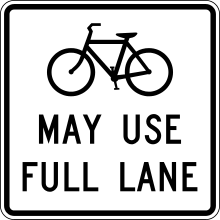 Opinion: Subtle doesn't always work. The remaining concern is that, maybe drivers will interpret that as a special condition of that section of road. These signs are standardized through the Manual on Uniform Traffic Control Devices (MUTCD), so customizing it to include the word "everywhere" would be discouraged. In Spokane's case, these signs may be appropriate along bike routes, but also in locations where the City posts the general speed limits.
 - The Real Risks in Urban Cycling
Source: City Lab; September 6, 2016
Summary: Bikes provide health benefits associated with physical activity, but there's also concerns associated with automobile crashes and bad air quality. A recent study has found, however, that in most cities, the health benefits provided by biking outweighs the risks.
Opinion: While this is likely true, the knowledge of the health benefits may not outweigh the visceral fear of having a car blast by you! Many of the benefits of biking will not be experienced by the general public until auto operators become more accustomed to the presence of bicyclists. Unfortunately, it is likely that there will still be a population that will remain hostile and aggressive, as noted in the story.
Showing posts with label air quality. Show all posts
Showing posts with label air quality. Show all posts
Four the Future - Urban Biking
Four stories about biking in urban areas: where to live, how to get a bike, where you can ride, and what will it do to you?


Four the Future - Oil and Methane
Today, methane sector air pollution is increasing, a massive methane leak is finally capped, there's limited information on oil train bridges, but some first responders are receiving new information in Washington.
- Air Pollution from Natural Gas Industry in Pennsylvania on the Rise
Source: Planetizen; August 27, 2016
Summary: As methane (natural gas) production increases, so does the amount of pollution this sector of the energy industry creates. This includes sulfur dioxide and volatile organic compounds (VOCs). However, this is more than balanced out by improvements in emissions by the switch to natural gas from coal.
Opinion: I've addressed fracking in the Marcellus Shale in the past. Lately, the EPA is moving to tighten methane emissions standards in the oil sector, where methane emission is a byproduct of oil production. There has been increased interest in regulation of fuel production at more than just the federal level.... - New oil train rule will give emergency responders advance notice of shipments
Source: Spokesman-Review; August 26, 2016
Summary: Beginning in October, the State of Washington's emergency responders will receive notice of crude oil shipments through their communities.
Opinion: Ecology's has set up a webpage concerning the new rule on the Oil Movement by Rail and Pipeline Notification web page. It is critical for public safety that the first responders have the information they need to manage an emergency situation. - California Declares State Of Emergency Over Months-Long Gas Leak
Source: National Public Radio; January 7, 2016
Summary: Methane was leaking in Southern California for months by the time of this article (which includes an audio story and video of the leak). The leak was originally detected on October 23, 2015. The operator stated that they finally stopped the leak on February 11, 2016.
Opinion: Methane is an odorless, colorless gas, but the article contains great video of what the leak actually looks like through an infrared camera. People had been driven from their homes due to the odor (the hydrogen sulfide added by utility companies) and cases of nausea. - Railroads keep most bridge inspection data secret
Source: Spokesman-Review; September 5, 2016
Summary: Federal law requires that railroads provide information on their bridges to local governments, but the information provided is limited. The bridges are inspected by the railroads based on the railroads "strong financial incentives" to keep them functional. Some of the bridges look unsafe, but what the bridges look like isn't important, just whether the bridge is safe or not.
Opinion: While it's probably true that the bridges' appearance isn't telling, the fact that the railroads won't explain how they are evaluating the bridges is telling. These organizations are dismissive of the public. They believe they're above examination. After events like the recent oil train derailment in Mosier, Oregon, they're going to find that the harder they resist input from the public, the harder the push back will be. They're almost guaranteeing that the hammer will come down harder on them in the end.
Four the Future - Air Quality
Four air quality articles, including an update to the Waste-to-energy mercury violation, power plants killing plant life, smoking-related deaths, and improvements in a world city's air.
- City, air agency could settle fine, upgrade incinerator
Source: Spokesman-Review; December 28, 2010
See also: Four the Future – November 3
Summary: The Spokane Regional Clean Air Agency has offered to settle a Waste-to-Energy air quality violation from last year for $5,000 and a required upgrade. During a test, the City of Spokane turned off a pollution control system they normally use to prove they didn’t need it. Under the deal, a carbon-based system will be installed at a cost of approximately $40,000. The director of the Spokane Regional Solid waste System says the cost won’t make much difference because the plant was already committed to using the new system.
Opinion: The attitude that argues that air quality control measures are unnecessary might stem from a philosophy of maintaining flexibility or being scientific in their approach, and not merely to thumb their noses at regulators. Indeed, the former what the city is claiming. Latest update: the city agreed. - Is coal-fired power plant killing farmers' trees?
Source: MSNBC; December 28, 2010
Summary: Farmers in central Texas are losing their crops, they say, because of the sulfur dioxide emitted by coal-fired plants. Sulfur dioxide, combined with water, makes sulfuric acid, a source of acid rain. It is known that sulfur dioxide kills trees, especially pecan trees. The Fayette Power Project has operated for 30 years, mostly without emissions control. The Lower Colorado River Authority, which operates the plant, and the state regulator both say it is not the plant's fault, but the EPA is suing Texas over its failure to enforce the Clean Air Act. There are 19 coal-fired plants in Texas. Each place where the trees are dying off there is a plant nearby. The EPA’s criminal investigation branch is getting involved. In the meantime, the Fayette plant is receiving a $500 million upgrade to scrub sulfur.
Opinion: This is one of the difficulties with coal, other than coal not being renewable and its combustion causing climate change. Coal contains about 1% sulfur. Lower quality coal (which is what is used because much of the high-quality anthracite has already been burned) has more sulfur.
- More Than 600,000 People Killed by 2nd-Hand Smoke
Source: ABC News; November 26, 2010
Summary: Annually, passive smoking causes about 379,000 deaths from heart disease, 165,000 from lung disease, 36,900 from asthma, and 21,400 from lung cancer. This accounts for about 1 percent of all deaths. This is in addition to the 5.1 million deaths caused by smoking. Children are especially affected due to SIDS, ear infections, pneumonia, bronchitis, and asthma.
Opinion: If smokers as a group killed 600,000 non-smokers a year by any other means, it would be called murder. Hopefully legislation such as the Washington Clean Indoor Air Act will show a reduction in deaths over time. However, since it doesn’t apply to homes, children will still be disproportionately harmed. - What's missing in Mexico City? Dirty air
Source: McClatchy; December 2, 2010
Summary: In 1991, Mexico City’s air had only 8 days with air quality below hazardous levels. This year, however, adequate to good air days has set a record of 193 days. This is a result of policies such as emissions testing every six months, reductions in lead and sulfur in fuels, and the relocation of the heaviest polluting factories. In 1989, the city created Hoy No Circula ("No Driving Today") that prevents driving one day per week. They also expanded the subway system and extended bus-only lanes for low-emission articulated buses. Still, ozone is a problem 180 days per year, complicated by the city’s high altitude.
Opinion: Mexico City is an mega-huge, sprawling city. Just like Los Angeles, it is heavily auto-dependent. And like Los Angeles, they have air quality issues and are embracing infrastructure-intensive transit as a solution. Smaller cities would be smart to heed the lesson and avoid the auto-centric, sprawling pattern that made those cities so dirty.
Air Quality - A Tease and a Warning
Last week I decided that this Wednesday's "Four the Future" would be about air quality, and I assembled the post. But tonight, I'm just going to make a quick mention that, in the interim, the Spokane Regional Clean Air Agency (SRCAA) has issued a stage two burn ban within the Smoke Control Zone due to poor air quality conditions.
According to the Spokesman-Review (Agency orders ban on burning, January 4, 2010), the last two times a stage two ban had been ordered were in April 1998 and February 1993. A stage two burn ban means that wood burning may only be employed if your home has no other source of heat. People with respiratory disease are urged to stay indoors and avoid exertion.
SRCAA states on their web site that the burn ban will remain in effect until air conditions warrant it be lifted. A storm capable of clearing out the tainted air may come by the weekend.
Four the Future - November 3
Today: helping you breathe easier.
- New U.S. Standards Take Aim at Truck Emissions and Fuel Economy
Source: New York Times; October 25, 2010
Summary: The Obama administration is proposing new fuel efficiency rules for heavy vehicles, mainly "tractor-trailers, buses, delivery vans, heavy pickup trucks, [and] cement mixers" for vehicles manufactured between 2014 and 2018. Changes are intended to reduce fuel consumption by 10 to 20 percent, depending on type. A recent study showed that fuel consumption could be reduced by up to 50 percent.
Opinion: The study cited above states that for the cost of $84,600 per tractor-trailer, fuel efficiency could be doubled, offering a return on investment of 10% as long as fuel was at least $1.10 per gallon. As of October 25, the cost of diesel fuel is $3.067 per gallon, up $0.266 from last year, which means the ROI would be much higher.
- Mercury emissions too high during incinerator test
Source: Spokesman-Review; September 17, 2010
Summary: During its annual air-quality testing, Spokane’s Waste-to-Energy plant failed its mercury emissions test. The plant has an effective "carbon pollution control system" to capture mercury prior to release, but it is turned off during testing to prove that it doesn't need it.
Opinion: Um, apparently, it does need it.
- Lowe’s and Wal-Mart pay multimillions in air pollution fines
Source: Los Angeles Times; October 29, 2010
Summary: Lowe’s will pay $2.75 million, and Wal-Mart will pay $2 million in a settlement for having sold paint that causes smog.
Opinion: One of the important parts of the green building movement is to make the places we occupy healthier for people. One of the requirements to qualify for recognition as a green building is the use of paints and coverings that emit fewer, or no, volatile organic compounds (VOC). Consumer Reports ran an article regarding these paints last year. Standards will change over time, producing improved respiratory health, but either our expectations for paint will have to change or the coverings industry must find ways to provide their product without harming their customers.
- Agency offers seminars on proper wood burning
Source: Spokesman-Review; October 21, 2010
Summary: The Spokane Regional Clean Air Agency (SRCAA) is offering seminars on how to burn wood cleanly at 11 AM to noon the next two Saturdays at three locations around the region. You may also receive more information directly from the agency with a brochure or DVD.
Opinion: Spokane sits in a big valley that, when there’s an inversion, the air near the ground cannot escape. In that case, all the smoke emitted by fireplaces stays here in the valley. The SRCAA is responsible for enforcing burning restrictions to maintain air quality in Spokane when there’s an inversion. When people burn cleanly, it not only improves our air quality, but clean-burners get to use their wood burning appliance when dirty ones cannot.

Subscribe to:
Posts (Atom)