Showing posts with label personal. Show all posts

Transportation and Public Health Survey

Yesterday, a group of volunteers and I worked for a couple hours for the Spokane Regional Health District surveying residents in the northwest corner of the East Central neighborhood and observing the physical conditions of their neighborhood. Survey AreaThis area (south of the Spokane River, east of Division, north of 2nd Avenue, and west of Sprague Way and the Hamilton overpass) is part of Spokane's University District. The effort was conducted to survey the residents' attitudes about the proposed pedestrian overpass between the Riverpoint Campus and the warehouse district. But, additionally, the survey's observations can serve as a baseline for any changes that occur due to investments made in the area. That is, we're taking the "before" picture. The results will be used to help inform the health district in their recommendation to the City of Spokane.
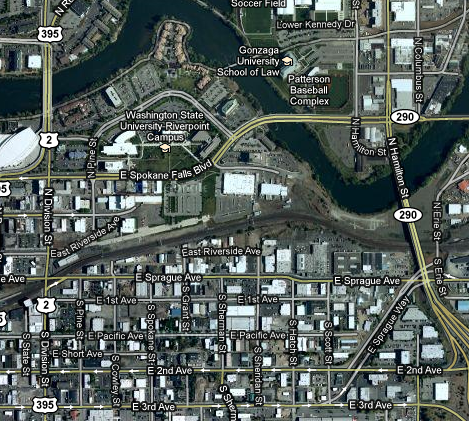
Wondering why this is being conducted by the Health District? The Health District has a Physical Activity and Nutrition program which, in part, encourages pedestrian and biking activity. The Health District is performing this research in order to estimate what kind of change in physical activity is likely to occur as a result in a change in the pedestrian infrastructure.

There was only about a dozen of us, but we did survey the entire area in just a couple hours. I was working with Mohammed Aly, another graduate student in the urban and regional planning department at EWU. The area we were assigned was the southeastern portion, mostly auto-oriented businesses, self-storage, some office spaces, and, from what we noted, one residence. We walked up and down the streets wearing orange vests assessing the prevalence of vandalism in the area, including graffiti and broken windows.

I think there's something very useful in having people actually take a look at their environment. It's difficult to change something unless you take the time to truly take a look at it. What I would have enjoyed in addition to this is to go with one of the residents and business owners (or more) to allow them to point out what they think is important. We did meet a gentleman there who certainly seemed engaged and willing to share his community with us, and I suspect it's not any different in many other places, too. In an ideal planning activity, you'd want to include that kind of data to ensure that you're not trying to solve a problem that doesn't exist in the minds of the people who are involved.

It was an excellent experience, one I'm looking forward to repeating, especially if the weather is as nice as it was yesterday!

For more information on the pedestrian bridge, and many other transportation- and transit-related projects in the downtown area, you are invited to an open house from 4:30 PM to 7 PM on Tuesday, March 29, at the Spokane City Council Chambers on the lower level of Spokane City Hall, 808 W Spokane Falls Blvd.

Thank you, IES-APA Part Deux

Last quarter I wrote about a couple of the books that I purchased for classes using the money I was awarded for a short essay I wrote entitled "The Purpose of Urban and Regional Planning." The $500 award was more than necessary to purchase my books for last quarter, so the remaining funds were used to purchase books this quarter.

The first book I purchased is the fifth edition of Urban Land Use Planning by Berke, Godschalk, Kaiser, and Rodriguez. (Now that I'm typing this out, I recognize Kaiser and Godschalk from an essay I read during my first quarter, "Twentieth Century Land Use Planning," which on my list of articles to review on this blog.) I purchased the book for PLAN 440 (Land Use Planning). Flipping through the pages I see that its pages are highly colorful with the pictures and graphics you'd expect from an undergraduate textbook.

The second book is the second edition of Understanding Your Economy by McLean and Voytek. This is the required textbook for PLAN 504 (Planning Methods II). It is published by the American Planning Association and conforms to the format that I've learned to expect from the APA, even in fonts and horizontal rules. This one, however, is beginning to show its age, as the exhibits are sometimes blurry or indistinct. And, certainly, the data is elderly and I noticed it is using SIC codes (valid from the 1930's) rather than NAICS (established in 1997). This is understandable as this second edition was first published in 1992.

I have one other class this quarter, PLAN 460 (Urban Design), but the bookstore is unaware of any textbooks which may be necessary. But, even if there were a book for it, the $500 ran out with the purchase of the two books above. Still, that's a total of five books which didn't come out of this poor student's wallet, and that is greatly appreciated!

Purpose-Driven Planning

A few days ago, I mentioned that I had won an award for writing an essay on the purpose of urban and regional planning. I am still grateful for the recognition, and glad that I had the opportunity to thank Tirrell Black, the Book Scholarship Subcommittee Chair, personally after a planning education event.

Today, I'm releasing the essay to the public to give it the opportunity to provide a new perspective on the public planning function. It is by no means the only possible purpose and I do not know to what extent this perspective is held by others. However, it is a purpose that resonates strongly within me, and I anticipate that it will inform my personal planning context quite strongly.

In order to have it be around for a while, I have published it as a permanent page on this blog. You can find it (at the time of the writing of this blog entry) on the top of the right hand column. But, you can also find the 547-word "The Purpose of Urban and Regional Planning" on that finely crafted link.

The AICP and Exam Study Guides

Planning is a profession, that is, it's not solely an academic activity in which people discuss theory and leave it at that. While theory is important, and certainly research is an important tool for establishing "the way things are," it is not in any way the focus of the industry.

Since planning is a profession, you shouldn't be surprised to know that planners can be certified, just, for example, as engineers can be. When you become certified, you join the American Institute of Certified Planners, and you earn the privilege of appending "AICP" to your name, as in "Josephine Planner, AICP." Being a certified planner means that you have been recognized by the industry as a professional in the craft, and that you are bound to the AICP code of ethics. Certified planners maintain their certification through the AICP Certification Maintenance program, which requires 32 hours of instruction every two years, and which must include at least 1.5 hours of planning law and 1.5 hours of ethics training.

In order to become a certified planner, you must achieve certain prerequisites, including a specified combination of education and professional experience. Once you have met these prerequisites, and are a member of the American Planning Association, you are eligible to take the AICP exam.

The AICP exam is administered twice annually, and the application and exam cost is currently $485. An exam outline is also provided by the AICP which also makes exam prep notes available in paperback and CD for $195.

Having said that, there are other study guides, too. The Washington APA offers the APA Chapter Presidents' Council Study Manual for $15. Online study guides also exist, such as the APA Florida Treasure Coast Section's AICP Exam 2011 Study Links.

The Treasure Coast Section's offering is an exhaustive list of links to books, reviews, and other resources, and I intend to spend a significant amount of time going through it. I'm glad to have found it. And how did I find it? Apparently someone found my blog entry regarding Michael Brooks' "Planning Theory for Practitioners" worthy of inclusion on the list. I am flattered, but the credit goes to EWU's Urban and Regional Planning program for inspiring (requiring?) the work. It just goes to show how the EWU program contributes to the future of our region.

Thank you, Inland Empire Section

Last quarter I submitted an essay to the Inland Empire Section of the Washington Chapter of the American Planning Association for their annual Student Book Award. Today, I'd like to publicly thank the IES for selecting my essay, "The Purpose of Urban and Regional Planning," as the first place entry. I am honored.

The essay contest is called the "Student Book Award" because the prize is a gift certificate to Spokane's EWU Bookstore. So far, I have purchased three textbooks, one for each of my classes this quarter, on the $500 prize. I may be able to purchase two more for next quarter.

Model Subdivision Regulations
Model Subdivision
Regulations
The books contain information about how to analyze policy similar to Lindblom's interpretation of the rational planning process, the law regarding the creation of subdivision ordinances, and how people perceive and react to the urban environment. I anticipate they will all be useful when I reflect upon the various functions within the planning profession.


So, thank you very much, IES members, for your assistance in my education. I hope I can return the favor someday.

Changes for a New Year

Happy New Year! After my first quarter as a graduate student and a heavy quarter of blogging about issues related to planning, I've learned a great deal about both the activity of planning and the activity of blogging. Some observations:
  1. Planning comes in many styles and planning theory has much to say about "how things ought to be."
  2. The blog stats seem to indicate that when someone stumbles upon the blog, they'll read several entries, but not ones with dates on them.
  3. I only rarely receive comments.
So, I'm going to make some changes around here. First, I'll be writing about what I've learned about planning theory and the activity called "community development." I have lots of articles I've read about planning activities around the country and around the world, and I'll abstract them for you in a way that I hope is interesting and applicable to our corner of the planet. Also, I will be changing "Four the Future" to have a theme, usually, and the theme will be in the name of the blog entry.

But, most importantly, I want to hear from you to find out what kinds of content you're most interested in. How can I make this blog better for you? As I've mentioned in another place, the product I want to create for this blog is "Knowledge and Hope." How can I best do that for you? The comment button is right down there, and I'd be grateful to see any observations you may have.

OK, that's it for now. Thanks for a great 2010, and I'm looking forward to a wonderful 2011.

A personal moment

If you're ever wondering why I do all this planning stuff, this photo of a brick on the campus of Eastern Washington University should be all you'll ever need to know.

Brian A. Sayrs Planning the Future for Alex and Jeff

Enrolled

Last Friday I was accepted into, and committed to enrolling in, Eastern Washington University's Urban and Regional Planning program. This blog will be dedicated to the process of attaining a planning degree, including notes on the classes I take, the books I read, connections between the planning theory and current topics in the community, and observations and questions I have relating to these.

I hope that this blog will be an opportunity for people to see what is involved in planning, its processes, the development of planning theory, and the practice of planning in a real life environment. I encourage people to comment and ask questions, as it may be something I can explain by learning it myself!

My background includes eight years as a city council member of Liberty Lake, Washington. I was a driving force behind creating the comprehensive plan and development regulations for the city, and worked in a quasi-judicial manner on several occasions. I also served on the Board of Directors of Spokane Transit and the Spokane Regional Transportation Council.

I am very concerned about how our institutionalized reaction to growth affects our natural environment and our individual and societal well-being. I hope that through this program I will better learn how to use the tools in the public realm to ensure that as this region grows it does not (at a minimum) harm our quality of life, but rather enhances it. I also hope to help develop new tools when the current tools are deemed insufficient.

I look forward to the conversation.