Showing posts with label economic development. Show all posts

Transportation and Public Health Survey

Yesterday, a group of volunteers and I worked for a couple hours for the Spokane Regional Health District surveying residents in the northwest corner of the East Central neighborhood and observing the physical conditions of their neighborhood. Survey AreaThis area (south of the Spokane River, east of Division, north of 2nd Avenue, and west of Sprague Way and the Hamilton overpass) is part of Spokane's University District. The effort was conducted to survey the residents' attitudes about the proposed pedestrian overpass between the Riverpoint Campus and the warehouse district. But, additionally, the survey's observations can serve as a baseline for any changes that occur due to investments made in the area. That is, we're taking the "before" picture. The results will be used to help inform the health district in their recommendation to the City of Spokane.
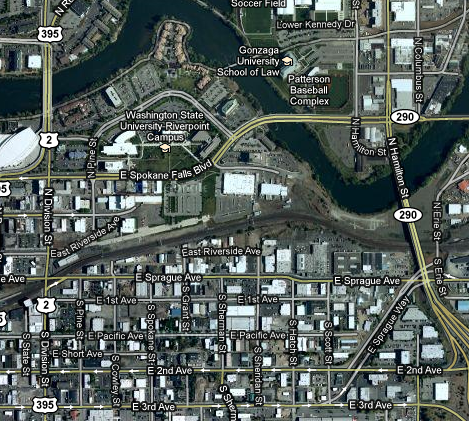
Wondering why this is being conducted by the Health District? The Health District has a Physical Activity and Nutrition program which, in part, encourages pedestrian and biking activity. The Health District is performing this research in order to estimate what kind of change in physical activity is likely to occur as a result in a change in the pedestrian infrastructure.

There was only about a dozen of us, but we did survey the entire area in just a couple hours. I was working with Mohammed Aly, another graduate student in the urban and regional planning department at EWU. The area we were assigned was the southeastern portion, mostly auto-oriented businesses, self-storage, some office spaces, and, from what we noted, one residence. We walked up and down the streets wearing orange vests assessing the prevalence of vandalism in the area, including graffiti and broken windows.

I think there's something very useful in having people actually take a look at their environment. It's difficult to change something unless you take the time to truly take a look at it. What I would have enjoyed in addition to this is to go with one of the residents and business owners (or more) to allow them to point out what they think is important. We did meet a gentleman there who certainly seemed engaged and willing to share his community with us, and I suspect it's not any different in many other places, too. In an ideal planning activity, you'd want to include that kind of data to ensure that you're not trying to solve a problem that doesn't exist in the minds of the people who are involved.

It was an excellent experience, one I'm looking forward to repeating, especially if the weather is as nice as it was yesterday!

For more information on the pedestrian bridge, and many other transportation- and transit-related projects in the downtown area, you are invited to an open house from 4:30 PM to 7 PM on Tuesday, March 29, at the Spokane City Council Chambers on the lower level of Spokane City Hall, 808 W Spokane Falls Blvd.

Four the Future - SARP

The Sprague/Appleway Revitalization Plan (SARP). For those who are unfamiliar with it, SARP is a plan adopted by the Spokane Valley City Council. There were several controversial aspects to it, including "down-zoning" areas along Sprague Avenue east of the Sprague/Appleway couplet, and converting Sprague back to two-way traffic. Several of the city councilmembers who supported the SARP were turned out of office in the following election by a group calling themselves the "Positive Change" coalition.
  • SARP Opposition
    Summary: At the west end of the SARP area, officially called the Gateway Commercial Avenue and Gateway Commercial Center zones, the rules for mixed-use development were changed by the "Positive Changes" coalition to allow Harlan Douglass and Elephant Boys operate an auto-sales business. This amendment occurred after Douglass had sued the city, but the city successfully defended the original denial. The planning commission had recommended that wall signs be banned above the first floor. Councilmember Rose Dempsey indicated support for that recommendation, but Councilmember Dean Grafos "abruptly shut down discussion" (Spokesman-Review, "Ordinance allows vehicle sales in mixed-use avenue zone", September 16, 2010) and the council overturned the commission's recommendation. A month later, in a 5-2 vote, the City Council voted to kill SARP with Bill Gothmann and Rose Dempsey in opposition. Gothmann argued that some plan needs to be in place, even if it's not SARP. Councilmember Bob McCaslin argued that there is a plan: private enterprise. Carlos Landa, who owns a strip mall that is 80% vacant at the corner of Sprague and Pines, said that he won't commit to invest $250,000 in improvements without a plan to revitalize the corridor.
    Opinion: The advantage of planning is that people can make commitments with the confidence that the plan will be executed. In other words, plans reduce risk and that encourages investment. In a wider context, the problem is more than mixed use area codes and down zoning, etc.:
    • Spokane Valley is totally lacking in identity, so they can't leverage that into a vision for the future. The absence of neighborhood councils contribute to this problem.
    • Spokane Valley is the definition of sprawl, with far more authority to develop than the economy could possibly support. As a result there is no guidance as to where people should invest in the community. It used to be that transportation and communications were limitations where a person would develop. But, with Spokane Valley's history of indiscriminate public "improvements," the aphorism "location, location, location" means nothing and Bob McCaslin's misguided denial of responsibility all the more disappointing.
  • Commission won't back zoning change
    Source: Spokesman-Review; December 16, 2010
    Summary: The new Spokane Valley City Council wanted a change to the comprehensive plan to allow an automobile dealership in the area the previous city council wanted to more walkable, more densely built city center. The city council declared an emergency declaration to change the plan out of cycle, and sent the change to the planning commission. The planning commission, however, did not see that there was an emergency and voted against the amendment.
    Opinion: The commission was responding to the changes the City Council requested on behalf of Pring Corporation between Sprague and Appleway on Dartmouth. One of the commissioners stated that they existed in order to assist the city council, and should consider the council’s recommendation. Another observed that they should not just rubberstamp everything. The second is correct. Congratulations to the Spokane Valley Planning Commission on having a backbone. Too bad the council will likely ignore them. Clearly, the city council has no idea what an "emergency" actually is. It's not a convenience for political considerations, but used for the adoption of regulations to protect the public health, safety, and general welfare.
  • Couplet likely to remain
    Source: Spokesman-Review; October 30, 2010
    Summary: While the Spokane Valley City Council has begun the process of discarding SARP, one of its elements, converting Sprague back to a two-way street, is still on the table. Except, there's no money. It would cost $1 million to restripe and change stop lights. Additionally, it would cost millions more if landscaping other tweaks are included. Mayor Towey believes that it will take 9 to 12 years to gather the funds to do such a thing. Business owners in the SARP area, pedestrians, and the fire district are opposed to the couplet, while many drivers prefer the wide open driving experience.
    Opinion: The article didn't mention the possibility that the state would force the City of Spokane Valley to repay the millions of dollars the state gave in grants to reconfigure Sprague in the first place. Spokane County engaged in some shenanigans to get that money in the first place, bypassing the Spokane Regional Transportation Council and spending money not authorized by the regional plan, so the other local governments will be less than excited to spend even more regional dollars on authorizing the change anyway.
  • Emergency ordinance Jan. 11 would bury vision of SARP
    Source: Spokesman-Review; January 1, 2011
    Summary: With apologies to Shakespeare, City Councilmember Rose Dempsey adapts Mark Antony’s oration at Julius Caesar’s funeral ("Friends, Romans, countrymen, lend me your ears") to plead for public involvement in the upcoming hearing regarding SARP’s fate. She points out that recently deceased King Cole had a vision for the City of Spokane, and great things happened. She says that disposing of SARP, which is intended to encourage the economy of a low-performing area of the city, is happening merely for the advantage of one person (presumably Pring).
    Opinion: In choosing Mark Antony’s speech to imitate, Councilmember Dempsey not only appears to supporting the SARP as a platform from which a reasonable plan can emerge, but also appears to be encouraging people to question the honor of the "Positive Change" coalition. After all, how many times can one person say that the "council is honorable and just" without others considering whether it is true or not? This is no mean disagreement. These are people fighting over the plan, and it has become highly political as important plans tend to become. But, it has also become personal, which is simply embarrassing.

Four the Future - December 27

Today, a macroeconomic view of the national economy and a discussion of a real problem which begs for long-range planning.
  • Many Americans are being more careful with their spending
    Source: Philadelphia Inquirer; November 12, 2010
    Summary: People’s spending habits are beginning to change. Looking for bargains is becoming a badge of honor. Bargain shops, including places like Goodwill, had a stigma, but those days have passed for many shoppers. One previously high-end shopper said, "My spending patterns will probably be a lot more conservative for the rest of my life."
    Opinion: Many people who lived through the Great Depression also had different spending habits from those who came after. When planners analyze economic growth projections, the prospect of a return of the ultra-consumerism of the last couple decades should not be accepted without significant evidence.
  • Iron fences just aren’t for everyone
    Source: Spokesman-Review; October 9, 2010
    Summary: The income gap between the richest and poorest increased to the greatest level ever. It’s not all bad: the rich seem to like it a lot. The top 20 percent of the population made almost 50 percent of the income. Those making $180,000 per year saw their incomes go up. Those earning $50,000 or less saw their incomes decrease. The 400 richest people in America made more money than the lowest 50 percent combined, more than 150,000,000 people. This is not new. In 1780s France, there was a huge gap in incomes. Of course, there were some bad moments for the rich including "several uprisings, a few guillotines." In the end, it all worked out (due, in part, to the guillotines).
    Opinion: We don’t even have to go that far back. The 1920’s demonstrated what was going to happen. Regulations were put in place to prevent another Great Depression. The plan was to separate commercial banking (which provided loans for things such as buildings) from investment banking (which takes higher risks to increase profits). There are other factors, but when those regulations were repealed in the 1990’s, they created the conditions necessary for the housing bubble. However, Congress doesn’t seem to have the statesmanship necessary to fix the problem this time.
  • Make Gov Work Sayrs Call-in
    Source: MakeGovWork; December 17, 2010
    Summary: The taxpayers with the highest incomes receive all of the same tax cuts as the middle class, yet the tax cut bill gives additional tax cuts beyond that. It seems unreasonable that people making $250,000 should be considered middle-class. The wealth inequality in America is causing inflation even as wages are going down, in part because the richest people in America, with their excess wealth, invest it in various industries. These industries are not worth more, but their cost does up because of excess investment case. Consequently, there is has been a succession of bubbles: the dot.com bubble, followed by the housing bubble, then the petroleum bubble. The people who suffer from this are the lower and middle classes.


    Opinion: Now, in this context, see how it affects the local economy, and the Spokesman-Review's uncritical boosterism....
  • Modest hopes harbored for commercial real estate
    Source: Spokesman-Review; December 12, 2010
    Summary: The River View Corporate Center in Spokane Valley lacks tenants. There is relatively high vacancy in the region, especially in the valley, making it a renter's market. Vacancy in downtown Spokane for Class A office space is 8 percent, but 17 percent for Class B space. More people will enter the market when it hits bottom, especially when they realize the stock market won't perform as well. The tax cut deal in Washington, D.C., is buoying hope that there will be more investment in commercial real estate.
    Opinion: Please note that it's a problem that it's a renter's market, but, apparently, that the problem will be solved when Congress puts us deeper in debt by encouraging the richest among us to continue with their distortionary investments. Seriously, is this our only alternative?

"Mixed-income housing, successes for whom?"

Because you all know I'm a party animal, and I certainly wouldn't want to disappoint any of you, tonight I was reading an article entitled "The Role of Public, Private, Non-profit and Community Sectors in Shaping Mixed-income Housing Outcomes in the US."

Yes, I know! As one of my friends quipped when I mentioned it, "I can't wait until you're in charge." I'm with ya, but I'd rather have noble, workable ideas in charge, not people. Can such ideas be found here?

The article outlines the two types of goals revitalization efforts can pursue. First are place-based goals, such as building of "housing stock, business development, telecommunications, water/sewer/electric and roadways" (Fraser & Kick, 2007, p. 2358). The second type are person-based goals which are the "building of individual and social capital so that they may take advantage of economic opportunities (such as, job skills development, educational improvement, poverty amelioration and moving people into homeownership)" (Fraser & Kick, 2007, p. 2358).

(Sidebar: this was written in 2007, before the general public realized that home ownership isn't always an economic opportunity. On the other hand, researchers engaged in urban studies really should have known better.)

The authors posit that successful achievement of these goals depends on 1) agreement upon the goals of the program between the public, private, non-profit and community sectors; and, 2) sufficient organizational capacity to achieve the goals. In effect, they say that even if everyone agrees, it is not enough until everyone is has the managerial skills and monetary resources to achieve them. They also observe that place-based goals are most easily achieved through cooperation between the private and public sectors and person-based goals are best achieved through cooperation between the non-profit and community sectors.

The article documents two neighborhood revitalization projects, one in Durham, North Carolina, the other in Chattanooga, Tennessee. The projects were similar (Fraser & Kick, 2007, p. 2362) in that they :
  • each are "an extension of the downtown revitalization effort";
  • "have the goals of creation of favourable people- and place-based outcomes";
  • "mobilised by a belief in the proposition that concentrated poverty is unhealthy"; and
  • private stakeholders...need to be persuaded to invest in the target areas".
Durham failed in a spectacular way, including public scandals and the total revamping of the Durham Housing Authority (DHA). Two reasons were given:
  • the DHA "did not have the skill sets or capacity necessary" (Fraser & Kick, 2007, p. 2366); and
  • "there was clearly less political will on the part of the public or private sectors to focus on the expressed goal of poverty amelioration" (Fraser & Kick, 2007, p. 2367).
Chattanooga apparently succeeded by changing the property value of the area, but significantly only for those who moved into the neighborhood. Original residents remained poor or were driven out by higher property taxes or incentive to sell at higher, gentrified, prices. The authors note that "many of the public-sector actors in Chattanooga were the private-sector actors" including the fact that two successive mayors of Chattanooga at the time were "both private-sector developers who own a great deal of downtown property" (Fraser & Kick, 2007, p. 2372). "Greater capacity through unity...could guarantee the place-based success of mixed-income changes" (Fraser & Kick, 2007, pp. 2372-3).

The central criticism of the piece is, "mixed-income housing, successes for whom?" (Fraser, J. C. & Kick, E. L., 2007, p. 2373). The answer as to whether revitalization efforts are successful depends on whether the focus is on the place (buildings, roads, and cable TV) or on actual real-live people.

Reference: Fraser, J. C., & Kick, E. L. (2007). The Role of Public, Private, Non-profit and Community Sectors in Shaping Mixed-income Housing Outcomes in the US. Urban Studies, 44 (12), 2357-2377.

Four the Future - October 1

Friday night: best time for posting? Nah. But I know you didn't want to keep waiting, right? So, tonight: four increasingly critical stories related to transportation, economic development and human rights.
  • Study: High-speed rail will create 13,000 jobs
    Source: Business Journal of Milwaukee; September 20, 2010
    Summary: A study was conducted regarding a proposed high-speed rail line between Milwaukee and Madison, Wisconsin. It found that it would create 13,000 new jobs, eliminate 780,000 annual car trips, and save 2.76 million gallons of gas per year.
    Opinion: Rail is a more efficient form of transportation. It’s not surprising that the reduction in costs and stimulating activation of land adjacent to rail stations would result in broad economic benefit. A study was conducted for light rail in the Spokane region, too, and it was found to create "about 17,300 jobs, $561.6 million per year in payroll, and $1.4 billion per year in output or value of goods and services produced," just in the first phase from downtown Spokane to Liberty Lake.
  • Millwood considering speed bumps to slow speeders
    Source: Spokesman-Review; September 30, 2010
    Summary: The City of Millwood is considering laying two speed bumps each along Riverway and Bridgeport, and a raised intersection at Empire and Fowler.
    Opinion: Maybe they’re not reading the blog. There seems to be some indication from a quote in the article that someone views speed bumps as punishment for speeders, and is failing to see that they are permanent "infrastructure-residents" of a neighborhood. Who volunteers to write a letter pointing out that there are alternatives to speed bumps?
  • Could 'Goldilocks' planet be just right for life? (includes video)
    Source: Seattle Post-Intelligencer; September 30, 2010
    Summary: Scientists using telescopes in Hawaii have discovered a planet orbiting the star Gliese 581 a. It is just the right distance from the star to be "not too hot and not too cold" for water to exist in liquid form. It is "tidally locked" which means one side of the planet is always facing the star (just like our moon is tidally lock to the Earth). The hottest parts of the planet would be 160 degrees and it would be -25 on the cold side. But at the terminator, where the star is constantly at the horizon, temperatures should be "shirt-sleeve weather."
    Opinion: OK, admittedly, this isn’t exactly in Spokane’s immediate neighborhood. This could be an interesting thought experiment for planners. In this case, there are significant environmental barriers, but many varied opportunities. For instance, in the hottest part of the planet, there’s plenty of solar radiation for energy production. But, no water there. Over time, I would think the liquid water be depleted, evaporating on the hot side, then snowing on the cold side, hidden from the sun and preventing the water from return. So, lots of frozen water for mining on the cold side. Look at that—the beginnings of an economy, and we’re not even there. But what else would be different? Would residents be recognized to have a right to clean air and water? Would they have a right to access to food and healthful agricultural products? A right to access to energy? What could we learn to help us understand our own world? Hopefully we’ll treat the natives better than we have in the past.
  • Slime Mold Transportation Network Design
    Source: Science NOW; October 1, 2010
    Summary: The IgNobel Awards were given out recently. There were several categories, but the grand prize of 100 trillion Zimbabwean dollars (value? US$0) was given to research with a slime mold. Hokkaido University’s Nakagaki Toshiyuki demonstrated that a slime mold, when provided bits of oatmeal for food upon a map, would spread out in a system which closely replicated the transportation system of Tokyo, Japan. Actually, it wasn’t exactly the same. It was slightly more efficient.


    Opinion: This is usually the job of transportation planners. And, yes, slime molds are brainless creatures. Thanks for asking.

Four the Future - September 15

No food shortage (yet), more grass-waste-to-energy, preserving habitat, and southern new urbanism.
  • Not a Food Crisis
    Source: New York Times; September 12, 2010
    Summary: In this editorial, the New York Times worries about the effects of a Russian ban on wheat exports. They argue that countries should not overreact and cause food crises by preventing the free flow of foodstuff across borders. India has had a ban in place, and it has resulted in rotting food stores. Large exporters should all agree to not impose controls.
    Opinion: Expect more of this. This year, one quarter of the sown wheat in Russia has been destroyed by fires fueled by drought. As climate change alters the food crops which can be grown in their traditional places, there will be upheavals. This is beginning to impose itself upon the consciousness of strategic thinkers. Source Integral has advised middle eastern nations that they should stop their strategy of outsourcing food (Part One) (Part Two) because there will be no place which will sell them food without a close, supportive relationship. We do not do food planning well in this nation. We depend, primarily, on abundance. But with our current reliance on international food trade, food prices intimately linked to oil prices, and regional responses to climate change, depending on hopes of abundance will not be a safe strategy in the future.
  • Ban on field burning prompts plan to convert straw to energy
    Source: The Oregonian; September 12, 2010
    Summary: Oregon had the same kind of grass smoke problems that other grass-burning areas have had. The problem got so bad that in 1988, intentional grass fires caused a 21-vehicle pileup on Interstate 5 killing seven and injuring a number of others. In 2007, Eugene-area legislators proposed to ban all burning. Consequently, several sites are now being considered to turn grass straw into "electricity, compost, fertilizer and compacted wood products."
    Opinion: This is a different approach to the grass-waste-to-energy concept presented before. Whereas the other project is being funded to make generators which operate on each farm, this concept brings it all together onto a larger site. While the previous concept has the benefit of providing distributed energy to independent farmers, the latter uses more of the plant for beneficial use, and could be base load bearing. It will be interesting to see which concept wins out, or if they can coexist side-by-side.
  • Bonneville Power Administration releases plan to protect 16,880 acres of Willamette Valley habitat
    Source: The Oregonian; September 11, 2010
    Summary: The Bonneville Power Administration is dedicating $125 million over the course of 15 years to preserve habitats due to the construction of dams in the Willamette Valley. The total area to be preserved is 16,880 acres. The State of Oregon, tribes, and nonprofits will be able to purchase conservation easements to protect diminished habitats. 9657 acres were preserved earlier. Rates will not rise, as it has already been taken into account. The draft is open to public comment until October 12.
    Opinion: The area to be preserved is about 2/3rds the side of the City of Spokane Valley. From these links, you can read the agreement and comment (scroll down to the “Willamette Mitigation Settlement Agreement” section). Not only do you live on this same earth as the fish that were affected by these dams, local power companies are BPA customers so you’re paying for these lands to be purchased and rehabilitated. If you have a comment to make, you certainly have a right to do so. I wonder...has anything like this happened in Washington?
  • Waco, Texas embraces growth and 'new urbanism'
    Source: USA Today; September 13, 2010
    Summary: Waco, Texas, used to be deserted when people went home from work. Now, there are people and cars and activity downtown because the city has embraced a mixed use plan for downtown. The market is moving toward walkability. They’re developing along the banks of the Brazos River. They’re leaving behind the sprawl and the high cost of "roads, utility lines, and services to remote areas." Tulsa and Baton Rouge are also focusing on this kind of development.
    Opinion: Light rail in Salt Lake City, new urbanism in Waco. Clearly, resisting these movements is not conservative, so what's the new excuse going to be?

Designing a Future Inland NW Eco-nomy

Got a note from Friend of the Blog, Sam Mace of Save Our Wild Salmon. I'll let her tell it:

Designing a Future Inland Northwest Eco-nomy: Visions for Rail Transportation and Restoring City Waterfronts in Clarkston, WA and Lewiston, ID

Where: Interdisciplinary Design Institute, Main Hall, Phase 1 Building, WSU Riverpoint Campus, 668 N. Riverpoint Blvd. Spokane, 99202

Reception at 6pm, Presentation at 6:30pm

Host: Sam Mace, Save our Wild Salmon sam@wildsalmon.org or 509-747-2030www.wildsalmon.org

What: View designs for rail transportation linking communities in the Inland Northwest as well as landscape architectural designs for the waterfronts of Clarkston, WA and Lewiston, ID if the four lower Snake River dams are removed and the riverfront restored. Speakers will include design students and business leaders.

Sponsored by: Working Snake River for Washington, Save Our Wild Salmon Coalition, and Washington State University.

Four the future - December 13

Access to Antoine Peak, Waste-to-Jobs, Spokane County jail, and inclusionary housing.
  • Access still limited to Antoine Peak
    Source: Spokesman, 091213
    Summary: While Spokane County has received grant funding for Antoine Peak, access is still limited because a third and critical piece of the property acquisition has not been made.
    Opinion: With the arrival of the grant monies, purchase of this final piece is easier. And if Spokane County withdraws the mind-boggling offer to purchase the YMCA, they'll save an immense amount of money for appropriate uses, like acquiring this third parcel.

  • Watching their waste
    Source: Spokesman, 091213
    Summary: Odessa Public Development Authority is developing a bio-digester at Fishtrap. In digesting 75,000 tons of waste, it will create fertilizer, generate enough electricity for 1,000 homes, and become Lincoln County's largest employer with 75 new jobs.
    Opinion: A great idea to deal with some of Spokane County's waste issues, but let's make sure there are no pathogens making it all the way into the resulting fertilizer. Good on Odessa PDA to look outside the box in being willing to place a site closer to Sprague than Odessa. With a little less provincialism everywhere, we'd all benefit with a little help from our friends. And look at that: Lincoln County's largest employer will be part of the green collar economy.

  • Jail query: not where, why
    Source: Spokesman, 091213
    Summary: A letter writer tells her experience about how a public hearing about the new jail facility turned from where should the facility be built to why should it be built, and brings facts to bear.
    Opinion: An excellent question: what is it about this "family friendly" community that requires so much jail time? The fact is that the county commissioners already picked a site, the best one, too, but the two Republicans on the board don't have the courage to stick to their decision. Beware Knezovich's recurring bids to create his own little kingdom out on the west plains.

  • Controversy surrounds Bellingham plan to require low-income housing
    Source: The Bellingham Herald, 091213
    Summary: The Bellingham City Council unanimously required a development to include 10% of the housing to be affordable to families making 80% of the Whatcom County median household income. There is disagreement over the appropriate method of ensuring the presence of affordable housing in an area. In Bellingham almost one-quarter of the cost of building a home is fees and sales taxes.
    Opinion: The fees argument is a red herring: who would live in a house that doesn't have access to roads, sewer, water, or schools? Or will fall down because it's uninspected? The question is: how do we ensure that there is a connection between the incomes in a community and the available housing stock. There are two ways: increase incomes for the least paid, or require that if incomes are low that there is housing stock available. Since there are so many people in leadership positions in this nation who hold the opinion that paying people well for their work is harmful to the economy (which is ridiculous because paying people IS the economy), the second must be pursued. What we need is to view affordable housing as a commodity, and create a market for it. Require all development to include a percentage of housing, including rentals, to be affordable, the percentage adjusted to the need in the region. Then, allow developers to transfer this requirement, if they wish, to other developers who would like to take advantage of government assistance. With protections to prevent affordable housing from being moved out of the local area and to prevent high concentrations of low income housing, a market is formed which is flexible and meets the needs of the region.