- Designing an Apartment Building for Bike Commuters
Source: City Lab; September 6, 2016
Summary: A new building in Malmö, Sweden is designed for biking residents and travelers. The building has no automobile storage, but each unit comes with a subscription to a carpool service. More substantially, the doors, elevators, and balconies are designed to accommodate the extra width demanded by handlebars. The motel rooms on the first floor come with an included bike rental.
Opinion: This building represents an alternative that most American cities would be unable to accommodate because their laws cannot make onsite automobile storage optional. Local laws almost always mandate that everyone, even people who do not own cars, must pay for auto storage in their homes. This could be alleviated if we eliminated parking minimums. - Biketown bike-share launches today: Five things to know
Source: The Oregonian; July 19, 2016
Summary: One thousand orange rentable bikes hit the streets in Portland in July 2016. You sign up on a website to check them out. The community is anticipating that they'll be used pretty heavily by tourists. Speaking of heavy, they do weigh in at 45 pounds, but with lights and an upright design, they're built for safety. And, yes, the parking for the bikes did displace some auto--and bike--storage locations.
Opinion: The Columbian followed up a month later. Rentals exceeded expectations. The City is awaiting the arrival of autumn weather to see how the program is affected. Portland is a bike-friendly city, so it should be anticipated that a bike rental program would be popular for the people who choose to visit, after all, it's part of what makes Portland Portlandia. It should be interesting to see the data and what effect, if any, it has on land use patterns. - Cyclists to Drivers: This Is My Lane!
Source: City Lab; September 9, 2016
Summary: Ohio is beginning to eliminate their "Share the Road" signs in favor of "Bikes May Use Full Lane" signs.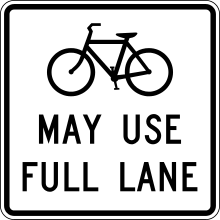 Opinion: Subtle doesn't always work. The remaining concern is that, maybe drivers will interpret that as a special condition of that section of road. These signs are standardized through the Manual on Uniform Traffic Control Devices (MUTCD), so customizing it to include the word "everywhere" would be discouraged. In Spokane's case, these signs may be appropriate along bike routes, but also in locations where the City posts the general speed limits.
 - The Real Risks in Urban Cycling
Source: City Lab; September 6, 2016
Summary: Bikes provide health benefits associated with physical activity, but there's also concerns associated with automobile crashes and bad air quality. A recent study has found, however, that in most cities, the health benefits provided by biking outweighs the risks.
Opinion: While this is likely true, the knowledge of the health benefits may not outweigh the visceral fear of having a car blast by you! Many of the benefits of biking will not be experienced by the general public until auto operators become more accustomed to the presence of bicyclists. Unfortunately, it is likely that there will still be a population that will remain hostile and aggressive, as noted in the story.
Showing posts with label parking. Show all posts
Showing posts with label parking. Show all posts
Four the Future - Urban Biking
Four stories about biking in urban areas: where to live, how to get a bike, where you can ride, and what will it do to you?


Four the Future - September 23
Today: Jefferson Elementary update, reducing energy costs, courthouse parking, and skateboarding!
- Board votes unanimously to move Jefferson Elementary
Source: The Spokesman-Review; September 23, 2010
See Also: Jefferson Elementary Public Forum
Summary: The Spokane School Board unanimously voted to move Jefferson Elementary to the west, reducing impacts on the children and saving $4 million.
Opinion: Unanimous. Apparently the board thought it was that clear. Of course, when public services are chronically underfunded, in this case they had no idea where more than half of the $4 million would come from, you don't even get to talk about the right and wrong of it. So is this right or wrong? Without the full public debate resulting in a neighborhood consensus, we'll never know.
- No heating necessary
Source: The Olympian; September 22, 2010
Summary: A house is being built in Olympia which is designed to use 75 less energy for heating by capturing sunlight, reducing heat loss from unintended ventilation, and extensive insulation. While it increased the construction cost by 7%, the savings from reductions in utility bills will pay off that difference in about 4-1/2 years.
Opinion: The payoff time is less than the term of a standard mortgage so, in effect, if you were to do this you'd actually be making money on the larger loan.
- Parking garage planned near courthouse
Source: Spokesman-Review; September 23, 2010
Summary: As part of the development of Kendall Yards, the area near the Spokane County courthouse may get a new parking garage. While there are property ownership issues to be resolved, the construction might begin as early as 2011.
Opinion: The only thing more legendary about the courthouse than the lack of fiscal responsibility by two of the county commissioners is the lack of parking in the area, the overdependence on surface parking lots, and the long walks through the adjacent neighborhoods associated with street parking. This is a wise move by Greenstone, who can tap an existing market for parking while creating an asset for bringing new businesses to the development.
- LL teen skates for record
Source: Liberty Lake Splash; September 22, 2010
Summary: Last weekend, Cohl Orebaugh skateboarded the most blunt-to-fakies in an hour to create a new category in Guinness Book of World Records.
Opinion: This is not even something the council remotely contemplated when we approved the construction of the skate park in Pavillion Park. No, this is unlikely to change the world, although, it is always nice to hear of someone setting a goal then achieving it. What's more important to realize is that human behavior is not linear. The council was just trying to create a safe place where local kids could enjoy themselves. Whatever people do when they plan for the future, they must also accept that things will not turn out as planned. They might, indeed, turn out better. Besides, this is your chance to find out what a blunt-to-fakie is. You should look just to know what it means that Cohl averaged one every 4.5 seconds for a full hour.
Four the Future - August 31
Today: signage blight, Intel-ligent vegetables, food carts, and parking lot tax proposal.
- Britain being "overrun" by street signs
Source: Reuters; Aug 26, 2010
Summary: There are so many signs, including traffic signs and advertising boards, that English cities are looking like "scrapyards." Money quote: "When busy Kensington High Street in central London was stripped of excess [signage], for example, it helped reduce accidents by 47 percent."
Opinion: This is a public safety issue, complicated by the fact that signage is nothing more than an arms race. Each sign is competing for your attention. If it becomes hidden behind another sign, it is expanded to take up more of your view. Eventually the community looks like a college dorm room. The only solution is to limit the size and number of signs to something that prevents anyone from attempting to gain an advantage over everyone else. - When geeks garden, radish technology advances
Source: News Tribune; July 12, 2010
Summary: Intel’s offices in DuPont, Washington, are sprouting gardens. They’re learning about the various vegetables they can grow, and are experimenting with soils amendments. They designed a hexagonal planting method. Their café produces compost from the four buckets of prep waste each day. “In late June they harvested 70 pounds of radishes from a 5-by-6-foot section of a raised bed.” Peas were coplanted with the radishes, so, even more produce will be coming from that same small amount of space. Intel encourages the activity because it saves time for the employees.
Opinion: Getting the cubical denizens some time outside in the garden is also going to increase the employees’ productivity and morale. And food banks in Pierce and Thurston Counties are benefiting from the oversupply of fresh vegetables. - Street renaissance under way in Vancouver
Source: Globe and Mail; July 9, 2010
Summary: Vancouver, British Columbia, is experimenting with creating an on-street food cart culture. When they offered 17 locations, about 800 vendors signed up. The city was looking to be more like Portland, Oregon, which has over 450 street food vendors. The locations will be subject to the health department. The CEO of the food services association was pleased with the enthusiasm. He expects that the carts would appeal to the “brown bag” crowd who don't visit the restaurants anyway.
Opinion: I was thinking about this topic in mid-June due the Spovangelist mentioning it and doing a lovely job of encouraging an expansion. I agree with her: Spokane could stand to have more of this kind of activity as well. (And now I'm thinking—wow! We were ahead of Vancouver, BC?! Not anymore.) At the time, I humbly suggested that we could kill two birds with one stone: license fees for surface parking lots, with a rebate for food carts on the lot. Well, imagine what I felt when I read the next story.... - Parking tax debate turns to growth
Source: Spokesman-Review; August 21, 2010
Summary: The City of Spokane is now considering an annual parking lot tax of $10 to more than $100 per space per year. The tax would go to street maintenance. This tax, however, would not generate much revenue. Mayor Verner is interested, but is more interested if it exempts structured parking. The owner of Diamond Parking agrees that parking is not the best use of land downtown, but the owners of the parking lots are merely holding the land, and making a few dollars, until such time as the economy supports building.
Opinion: There is an immense amount of parking available in downtown Spokane. And, hey, if they don’t want to pay the tax, they can make a food cart stall, perhaps! Or they can do any of these other things, ideas kindly supplied by the Spovangelist and friends.


Four the Future - August 29
- Risk-Taking Rises as Oil Rigs in Gulf Drill Deeper
Source: New York Times; August 29, 2010
Summary: Oil rigs have been built farther and farther out into the Gulf of Mexico. However, risks do not increase with increasing depth of drilling, but, instead with greater complexity. While the ill-fated Deepwater Horizon was only a drilling rig, Shell's Perdido rig "can drill and pump oil from wells across 30 miles of ocean floor. Below it is a subsea cityscape of pumps, pipes, valves, manifolds, wellheads and blowout preventers...." Undersea drilling had been deemed safe due to a limited number of reported accidents. But, according to a former industry executive, "Our ability to manage risks hasn't caught up with our ability to explore and produce in deep water."
Opinion: The issue here is not that they're drilling deeper, but that our energy consumption isn't linked to the risks being experienced. If the nation's petroleum users are willing to take those risks, that's fine, but it should be a conscious decision. Additionally, the full costs associated with those risks should be borne by their consumers. The BP oil spill proves that this nation is not fully allocating those costs, not doing enough to mitigate those risks, nor prepared to deal with the consequences when those risks are realized. Ultimately, when someone argues that it's too expensive to deal with those issues, they're admitting that this nation is not willing to pay the price of our current petroleum addiction. - Free parking isn't free
Source: The Spokesman-Review; August 29, 2010
Summary: Editor Gary Crooks discovers Donald Shoup's "The High Cost of Free Parking." He makes an estimable stab at the topic, laying out the problem with the hidden costs of "free" parking built into everything we buy, and into every time we travel.
Opinion: the problem is not that it costs money to park, but that local government, through its land use code, has forced such a massive oversupply of parking that it's literally worthless in most places. In addition to being a massive waste of space, it moves every place you want to get to farther apart, necessitating the ownership of a car to get around. You can check it out from the Spokane City Library. Predictably, it's not available at Spokane County or Liberty Lake libraries. - Homebuilders hope boomers beat a new path to their doors
Source: The Spokesman-Review; February 7, 2010
Summary: Homebuilders are pleased that the baby boomers are aging and wanting to downsize their homes. A quarter of the US population will be 55 or older in 2014. While 60 percent want to stay in their homes, the remainder want alternatives. More than 75 percent of these potential homebuyers want to live in the suburbs. They're only wanting to pay $190,000, though--a far cry from the $287,000 the builders want.
Opinion: They can't live in the suburbs. For the past 50 years, governments have been making rules (which the baby boomers wanted) to prevent this kind of development. They want 1,900 square foot houses, which means that they're only paying $100/square foot which means either: 1) lower quality finishings, which they won't like because they compare unfavorably from what they came from, or 2) less land between the houses, which is not suburbia. They're also likely to be looking for homes with just one floor to make getting around easier. But, that also takes more land for the same space. Plus, they don't have as much equity as they think. If so many baby boomers want to move, the massive number of houses on the market will push prices down. Elected officials have been told this was going to happen for at least a decade, and it takes that long to get substantial change in the land use patterns. But, I guess, at least I'm happy that while the solution has been staring Spokane and the region in the face for a long time, at least there's an article in the newspaper which shows that someone has gotten up to noticing that there might be a problem. (By the way, Liberty Lake has a development on Appleway which may help with this problem despite significant opposition on the council and a self-defeating limit on density.) - Seattle may create transportation taxing district
Source: The Seattle Times; August 10, 2010
Summary: Seattle is considering the creation of a transportation benefit district (TBD) to fund transportation projects within the city. TBD's are permitted to charge a $20 car tab fee without a vote of the people, and up to $100 with a public vote. Additionally, the TBD may also charge 0.2 cent sales tax and property taxes with a public vote.
Opinion: This is the same type of district that the City of Spokane is considering for its well documented transportation woes (not congestion because the concept of congestion in Spokane is laughable, but asset preservation). There is another TBD in Spokane County already--the Liberty Lake Trails TBD which built a number of trails connecting throughout the community, and, with the help of the city, the pedestrian bridge over the freeway. However, that was an older version of the TBD statute which only authorized a property tax. The $20 car tab fee is new.
Four the Future - January 24
Today: Parking policy, greenhouse gas inventory, seeking public input, and climate change planning.
- Seattle to allow all-day parking lots near light-rail stations, after all
Source: Seattle Times; January 11, 2010
Summary: Despite a ordinance which bans it, newly seated Seattle Mayor Mike McGinn will permit all day parking near Link light rail stations. Originally, the plan was to ensure that parking was limited to only a few hours per day. It was intended to help local businesses by making sure available parking wasn't taken up by light rail customers, and to protect local neighborhoods from a flood of commuter traffic. However, local businesses near McGinn's campaign office asked for the change last year. A new proposal will be made later this year.
Opinion: Parking is a bizarre topic for planners because no one seems to know what amount of parking is appropriate. What I do know is that our policies are wrong, wrong, wrong because they almost always fail because the same policy can be too much in one location, and too little in another. Part of the problem is that parking is free. Well, actually, it isn't: it's built into the cost of every product and service in the nation, but no one recognizes it. And you pay it whether you park for 1 minute or 8 hours or not at all. The more people who know about the seminal work The High Cost of Free Parking (Amazon, $48.28), the better our cities and towns will be. What it argues, in part, is to let the market decide how much parking is worth, rather than having a government mandate to increase the amount of parking and crush the market into worthlessness. I agree. - Climate Protection
Source: City of Vancouver, BC; December 2009
Summary: the City of Vancouver, British Columbia, has published its Greenhouse Gas Emissions Inventory (PDF, 4.86 MB). It calculates the amount of GHGs that are being emitted by category, such as commercial buildings, residential buildings, and transportation. Vancouver has much to be proud of, as they have reduced GHG emissions to 1990 levels, and the document states the city's belief that it will reach Kyoto goals in 2012. Vancouver has the lowest per capita major city GHG emissions rate in North America at 4.6 metric tonnes. Seattle is 7.1; Portland is 11.9.
Opinion: In an easily readable form, the City of Vancouver has shown that it's possible to document and track GHG emissions. Everyone should be doing this, because you can change what you can measure. - Choices for Cheney
Source: City of Cheney; January 19, 2010
Summary: The City of Cheney's comprehensive planning process, Choices for Cheney, is going on the road. the city is displaying data regarding their plan for the year 2030 in various locations around the city, even at multiple locations on Eastern Washington University's campus. Additionally, the displays are staffed to receive in-person input and answer questions.
Opinion: Plans which are not rooted in public input are worse than useless. For Cheney, in particular, bridging the gap between the university and the rest of the community is important. Kudos to Cheney Community Development Director Brian Jennings for taking it to the people where they learn and work and shop. As a member of the Cheney community, I will be visiting one of the displays so I can reemphasize the importance of housing for low income transitory populations (students!) near the university. As long as the land is available on the edge of the city, there will be more apartments and more transportation headaches (both roads and parking) to deal with. New multifamily housing is mandatory. Where they put it should be obvious. - Water planners look ahead
Source: The Spokesman-Review; January 23, 2010
Summary: the Army Corps of Engineers is working with the University of Washington's Climate Impacts Group to determine changes in the way dams are used to deal with flooding. As the climate changes, more water is running off in the winter, and less is flowing in the spring and summer. The simulations are anticipating a global change of +3.6 Fahrenheit (+2 degrees Celsius) by 2050.
Opinion: This is the tip of the melting iceberg. A couple of years ago, reinsurance companies started to raise rates for hurricane damage on the American east coast. It's getting very expensive and in some cases difficult to purchase. And it's becoming necessary in places as far north as Connecticut. This is an example of the market responding to climate change, not scientists. Time to get serious.
Subscribe to:
Posts (Atom)