- This Tiny Roadside Refuge in Silver Spring Is Your Sorriest Bus Stop, America
Source: StreetsBlog USA; July 8, 2016
Summary: StreetsBlog USA had a tournament of "sorry" bus stops. The tournament allowed readers to vote of how bad the bus stops were. The worst is in Maryland, where the bus stop is completely inaccessible to pedestrians. There is hope, however, as there has been a request to fund a pedestrian crossing so people don't have to take their lives into their hands just to catch a ride.
Opinion: If you follow the link in the story to the Washington Post article, you'll see that it used to be even worse--probably because none of the responsible agencies would take responsibility. And, what's the effect of this kind of infrastructure? Little, except perhaps reinforcing the perception that transit is mainly for people who don't have a choice, because who, exactly, would use this bus stop if they had an alternative? - TransLink report highlights chronic overcrowding and record ridership
Source: CBC News; September 8, 2016
Summary: The transit system in Vancouver, British Columbia is experiencing overcrowding even outside of peak times. The federal and provincial governments have committed to expansion plans. TransLink is in talks with local governments to find the additional revenue needed to expand service.
Opinion: Many transit systems experienced expansions in the last decade as communities experienced a significant shift in their travel habits. The increase in demand must have a spatial effect, as transit is concentrated in specific locations. So what's the effect of high ridership? Consider the increased value of the land and buildings adjacent to places with significant transit investment, as in the next story. - Watching Los Angeles Gentrify
Source: City Lab; September 6, 2016
Summary: There appears to be a correlation between the construction of transit lines in Los Angeles and the increase in the value of the adjacent neighborhoods. In neighborhoods where transit investments were made, "residents became whiter, richer, and more educated." People with lower incomes were displaced.
Opinion: It makes perfect sense that when a service that is valued is added to a location, the location's value goes up. However, it is not correct to assume that because the location's value goes up that the people who live there can continue to afford it. I've mentioned this before and it bears repeating. Just because you make improvements in an area doesn't mean that the benefits will go to those who currently live there. Indeed, you may tear the neighborhood apart. You must be mindful of whether the benefit is designed to help the place or the people. - When Light Rail Opens, Do People Really Get More Exercise?
Source: City Lab; September 8, 2016
Summary: One of the benefits touted for transit use is that people who live near light rail stations walk more. But, it may be that the level of exercise you get is actually related to how much exercise you got before--only sedentary folks increased physical activity. Bus trips may have been replacing walking and biking trips for more active people. There is still much we must learn about how transit affects neighborhoods.
Opinion: It makes sense that one change to a person's environment may not be enough to change a person's habits all by itself. Certainly, when a person has already made a commitment to physical activity, adding transit wouldn't alter that too much. But, as the study notes, getting a sedentary population to walk more is a significant public health win. Providing focused assistance to this population might have a great effect. (Need I note that many Americans are part of this population?)
Showing posts with label public health. Show all posts
Showing posts with label public health. Show all posts
Four the Future - Transit Effects
Today: Bad transit stops, increasing transit demand, changing transit communities, and a transit public health win.


Transportation and Public Health Survey
Yesterday, a group of volunteers and I worked for a couple hours for the Spokane Regional Health District surveying residents in the northwest corner of the East Central neighborhood and observing the physical conditions of their neighborhood. 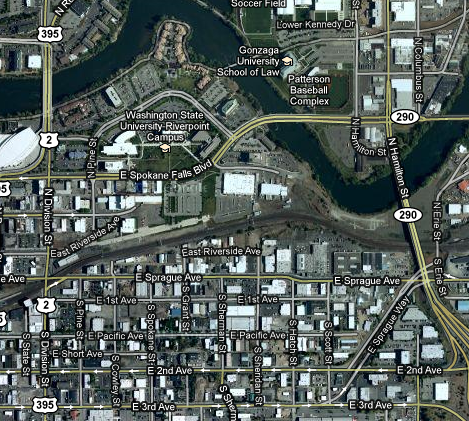 This area (south of the Spokane River, east of Division, north of 2nd Avenue, and west of Sprague Way and the Hamilton overpass) is part of Spokane's University District. The effort was conducted to survey the residents' attitudes about the proposed pedestrian overpass between the Riverpoint Campus and the warehouse district. But, additionally, the survey's observations can serve as a baseline for any changes that occur due to investments made in the area. That is, we're taking the "before" picture. The results will be used to help inform the health district in their recommendation to the City of Spokane.
Wondering why this is being conducted by the Health District? The Health District has a Physical Activity and Nutrition program which, in part, encourages pedestrian and biking activity. The Health District is performing this research in order to estimate what kind of change in physical activity is likely to occur as a result in a change in the pedestrian infrastructure.
There was only about a dozen of us, but we did survey the entire area in just a couple hours. I was working with Mohammed Aly, another graduate student in the urban and regional planning department at EWU. The area we were assigned was the southeastern portion, mostly auto-oriented businesses, self-storage, some office spaces, and, from what we noted, one residence. We walked up and down the streets wearing orange vests assessing the prevalence of vandalism in the area, including graffiti and broken windows.
I think there's something very useful in having people actually take a look at their environment. It's difficult to change something unless you take the time to truly take a look at it. What I would have enjoyed in addition to this is to go with one of the residents and business owners (or more) to allow them to point out what they think is important. We did meet a gentleman there who certainly seemed engaged and willing to share his community with us, and I suspect it's not any different in many other places, too. In an ideal planning activity, you'd want to include that kind of data to ensure that you're not trying to solve a problem that doesn't exist in the minds of the people who are involved.
It was an excellent experience, one I'm looking forward to repeating, especially if the weather is as nice as it was yesterday!
For more information on the pedestrian bridge, and many other transportation- and transit-related projects in the downtown area, you are invited to an open house from 4:30 PM to 7 PM on Tuesday, March 29, at the Spokane City Council Chambers on the lower level of Spokane City Hall, 808 W Spokane Falls Blvd.
Four the Future - October 28
Foodies, rejoice! Home grown chickens, new local restaurants, community gardens, and, sadly, more diabetes to come?
- Council broods over looser chicken regulations for Valley
Source: Spokesman-Review; September 25, 2010
Summary: A citizen requested that the Spokane Valley City Council expand the number of places where chickens can be raised. Currently, it is restricted to lots of at least 40,000 square feet (almost an acre). There are currently 1,300 single-family lots of that size, and code enforcement receives one or two complaints a month.
Opinion: First, city dwellers, you do not need a rooster for eggs. You only need hens for that. If you want more chickens, then, that is when you need roosters...and a lot more distance between you and your neighbors. Odor can be a problem, so the city should be prepared to enforce strict hygiene standards. Second, city dwellers, it is crazy that there are 1,300 single-family residences of one acre or larger in a city. But, the history is that they were in existence prior to the Growth Management Act, so there are few things that can be done about it now except prevent the creation of more. But, I'm not sure that Spokane Valley is committed to that concept.
- Tripling of diabetics possible
Source: Spokesman-Review; October 23, 2010
Summary: If current trends continue, there may be a tripling of the number of diabetics in America by 2050, up to one third of all adults. While part of the increase is due to diabetics living longer, much of it is due to obesity rates.
Opinion: Hey, what if there were an alternative to all the fatty, sugary foods we eat? Hmmm.... - Shared farming program harvests food, community
Source: Spokesman-Review; October 24, 2010
Summary: An acre of surplus land that was doing nothing but being mowed was converted to gardens this year to benefit the Dalton Gardens community. A group recruited 30 "shareholders," half paying $200 up front, the income-qualifying other half paying nothing. Then, all participants received a box of produce every other week all summer. The income-qualifying families paid just $10 per box of food. First-graders from Dalton Elementary participated by planting the pumpkins and came back as second-graders to harvest them.
Opinion: Educational, local, organic urban farming which supports the efforts of local food banks. Seriously, how do you beat that? And, the waiting list is long. I know of several acres owned by Vera Power and Water at 16th and Sullivan. All it is doing is being irrigated and mowed. Where is the local underutilized lot in your neighborhood? Is it yours? (Hey, Angie Foltz: I know you have something to say about this!)
- Despite slow economy, new eateries are springing up all over
Source: Spokesman-Review; October 24, 2010
Summary: There are a large number of new restaurants opening in the Spokane-Coeur d’Alene region. People are beginning to go out again, especially to neighborhood locations. Banks are supplying funds to people who are attempting to get jobs by creating them, provided they have management experience.
Opinion: A weak economy with people looking for paradigm-changing food choices will mean many restaurant failures. That, in itself, is nothing new. But, humbly, I recommend that these new restaurateurs attempt to leverage the local, organic movement just in case. It will capture those people who want it, but have not found the way to achieve it just yet. Better yet, make sure you have a garden, and show people how you connect to it! Show me themoneyfreshly grown vegetables!
Four the Future - October 6
Cell towers in the 'burbs, Wi-Fi in the sticks, losing health care out yonder, and sprawling taxes.
- Bend considers cell phone tower restriction
Source: Oregonian; September 10, 2010
Summary: The City of Bend, Oregon is considering restrictions on cell phone tower size and location which may ban them from residential areas.
Opinion: Cell phone towers are a common planning issue because they are considered visual blight. Yet, cell phone use is on the rise. Indeed, smart phones require even greater access for their heavy Internet usage. The issue is that of community density, ultimately. It's difficult to provide cell service to a widely spread out area. Some alternatives include a requirement for collocation (that is, requiring that several carriers utilize a single tower, when possible) and camouflaging them to appear as something else, like trees.
- Federal grant bringing Wi-Fi to rural Inland Northwest areas
Source: Spokesman-Review; September 15, 2010
Summary: A federal grant is paying for the installation of WiMAX (4G) technology in rural areas of Spokane, Stevens and Ferry counties which generally do not have access to wired broadband service. The grant was made available through the American Recover and Reinvestment Act (ARRA or "the stimulus"). It will be available to approximately 3,600 businesses and 30 community groups. Nonprofits will receive service at half the price. Speeds can be as high as 10Mbps.
Opinion: Servicing rural areas with any modern technology is expensive, hence the state’s emphasis on restraining sprawl. Rural electrification was done the same way, with significant government intervention.
- Providence to close Deer Park rehab clinic
Source: Spokesman-Review; September 29, 2010
Summary: Providence Health Care is closing Deer Park's clinic because Providence is unwilling to make upgrades.
Opinion: A couple years ago, they closed down the hospital, too. Impossible to say, but this could be caused in part because way too much of the money we spend on health care goes to insurance companies rather than supplying actual help.
- Boundary changes considered for eastside elementary schools
Source: Liberty Lake Splash; September 29, 2010
Summary: Due to growth within the Central Valley School District, a planned elementary school will already be over capacity the day it opens.
Opinion: This is another problem with sprawl. Spokane (District 81) School District recently closed an elementary school because of low enrollment. Yet, right next door in Central Valley, they're behind by one elementary school, and even that one will be full the day it opens. So, there's no net benefit, but a huge capital cost.
Four the future - January 4
And we're back! Today: planning is contentious, greenhouse planning, skyscrapers, and another of poverty's costs.
- The quest to designate Portland's growth areas sets counties against each other
Source: The Oregonian, 091227
Summary: Washington, Clackamas, and Multnomah Counties, Oregon, will increase in population by one million in the next 20 years. Washington County is arguing that it is the economic engine of the region and need extra space for growth. Clackamas County agrees with the Washington County Farm Bureau, saying that too much farmland is being destroyed by Washington's proposals. Metro, which is responsible for creating the plan, has offered a map which creates 24,000 acres of additional urban reserve areas and 224,000 acres of rural reserve lands (pdf map, 7.22MB). The intent is to allow for 40-50 years of predictability for both government, and private sector decision makers. There are nine areas on the map where there is disagreement.
Opinion: Portland, Oregon, and its suburbs are the poster children of good urban planning. It is instructive, therefore, to realize that even when the broad goals of growth management are embraced, there is contention. Just because there's disagreement doesn't mean that planning, as a function, is a failure. Indeed, if everyone always agreed, neither planning nor politics would ever be necessary. - Air Quality Guidelines Face Unexpected Critics
Source: The New York Times, 091226
Summary: San Francisco will soon be responsible for regulating the emission of greenhouse gases. The guidelines being considered by the air pollution control authority would cause larger developments, both suburban and urban, to pay fees for emissions mitigation. Previously, developments in previously urban areas were exempt from environmental review.
Opinion: A couple of the problems with some planning schemes is that they exempt small projects and only lay requirements on larger ones, and they treat each project as an individual problem rather than as a part of a regional issue. For example, here in Washington, you can use water from a residential well without a permit. As a consequence, thousands of individual wells have been drilled. Each one has limited impact, but as a group, it's having a major impact on those who have issued water rights. Shared resources, such as water and air, could be managed by individual requirements mitigated through a transfer of development responsibilities. - Redefining skyscraper
Source: The Spokesman-Review, 100104
Summary: The Dubai Tower, Burj Dubai in Arabic, opened Monday under tight security. The actual height has been kept a secret, but it is reported to be 2,684 feet. The second tallest occupied building in the world is the Taipei 101 at 1,667 feet. Not only is Burj Dubai the tallest occupied building, but also the tallest structure, beating out a broadcast mast in North Dakota.
Opinion: First thought: this is a legacy of the real estate bubble, just like the massive housing bubble here in the United States. Just because there's money to do it doesn't mean it's a good idea. Adam Smith's "Invisible Hand" can be defrauded, too. Second thought: I wonder what kinds of transportation assets they have for this massive structure. If they're dependent on automobiles, I wonder how many of its 124 stories is a parking garage. Third thought: The City of Spokane turned down the construction of the Rob Brewster's 32-story Vox Tower because it was one block outside the downtown core, which prevented the 300-foot tower from being built over 150 feet (amongst other objections which came along after the cited article). Currently the tallest building in Spokane is the 22-story, 288-foot Bank of America Building. - Poverty shortens healthy years
Source: Los Angeles Times, 091228
Summary: Poverty is the strongest predictor of poor health, even greater than lack of education, smoking, and obesity according to a study published online in the American Journal of Public Health on December 17, 2009. The average person who earns less than 200% of the federal poverty guideline, which is the bottom third of all earners, will lose 8.2 years of good health. Other factors reduced health expectancy less: smoking by 6.6 years, high school dropouts by 5.1 years, and obesity by 4.2 years.
Opinion: Just like public safety and welfare, public health is a planning issue. If you want a growing community, with lots of available workers and low absenteeism costs, make sure your community pays well enough for people to have access to robust preventative medicine. If you don't, be prepared to get hit by high medical costs.

Subscribe to:
Posts (Atom)