- This Tiny Roadside Refuge in Silver Spring Is Your Sorriest Bus Stop, America
Source: StreetsBlog USA; July 8, 2016
Summary: StreetsBlog USA had a tournament of "sorry" bus stops. The tournament allowed readers to vote of how bad the bus stops were. The worst is in Maryland, where the bus stop is completely inaccessible to pedestrians. There is hope, however, as there has been a request to fund a pedestrian crossing so people don't have to take their lives into their hands just to catch a ride.
Opinion: If you follow the link in the story to the Washington Post article, you'll see that it used to be even worse--probably because none of the responsible agencies would take responsibility. And, what's the effect of this kind of infrastructure? Little, except perhaps reinforcing the perception that transit is mainly for people who don't have a choice, because who, exactly, would use this bus stop if they had an alternative? - TransLink report highlights chronic overcrowding and record ridership
Source: CBC News; September 8, 2016
Summary: The transit system in Vancouver, British Columbia is experiencing overcrowding even outside of peak times. The federal and provincial governments have committed to expansion plans. TransLink is in talks with local governments to find the additional revenue needed to expand service.
Opinion: Many transit systems experienced expansions in the last decade as communities experienced a significant shift in their travel habits. The increase in demand must have a spatial effect, as transit is concentrated in specific locations. So what's the effect of high ridership? Consider the increased value of the land and buildings adjacent to places with significant transit investment, as in the next story. - Watching Los Angeles Gentrify
Source: City Lab; September 6, 2016
Summary: There appears to be a correlation between the construction of transit lines in Los Angeles and the increase in the value of the adjacent neighborhoods. In neighborhoods where transit investments were made, "residents became whiter, richer, and more educated." People with lower incomes were displaced.
Opinion: It makes perfect sense that when a service that is valued is added to a location, the location's value goes up. However, it is not correct to assume that because the location's value goes up that the people who live there can continue to afford it. I've mentioned this before and it bears repeating. Just because you make improvements in an area doesn't mean that the benefits will go to those who currently live there. Indeed, you may tear the neighborhood apart. You must be mindful of whether the benefit is designed to help the place or the people. - When Light Rail Opens, Do People Really Get More Exercise?
Source: City Lab; September 8, 2016
Summary: One of the benefits touted for transit use is that people who live near light rail stations walk more. But, it may be that the level of exercise you get is actually related to how much exercise you got before--only sedentary folks increased physical activity. Bus trips may have been replacing walking and biking trips for more active people. There is still much we must learn about how transit affects neighborhoods.
Opinion: It makes sense that one change to a person's environment may not be enough to change a person's habits all by itself. Certainly, when a person has already made a commitment to physical activity, adding transit wouldn't alter that too much. But, as the study notes, getting a sedentary population to walk more is a significant public health win. Providing focused assistance to this population might have a great effect. (Need I note that many Americans are part of this population?)
Four the Future - Transit Effects
Today: Bad transit stops, increasing transit demand, changing transit communities, and a transit public health win.


Monroe/Lincoln Construction Update
This is an update to the post a few days ago that addressed the effect of road reconstruction on business in downtown Spokane. Anyone who has driven on the Lincoln or Monroe in the last few years knows that this road needed to be reconstructed. The surface was, shall I say, bone-jarring and carries a heavy traffic load.
This reconstruction is particularly complex due to the number of utilities and vaults under the right-of-way. Fortunately, the City made the decision to replace all of the infrastructure at the same time. This situation would be worse if the road had to be "opened up" several times rather than just once because road construction does reduce access to the adjacent businesses.
There is some concern that the construction won't be completed by the end of this construction season, which would mean that the road would be patched up to winter over, then they'd finish the work next year. City Council President Ben Stuckart asked public works to address the concerns, and the council was told that there was a delay in the bidding process because of a delay in federal approval. In an attempt to get the project back on schedule, overtime hours had been paid and there would be more if there was an indication that it would help.
In the meantime, the City has announced that paving will begin on September 17. Work will continue into November.
Some business associations are working together to try to help out the restaurants. While I'm sure the effort is appreciated, the benefit of the partnership between a couple of organizations that normally work together will not bring a huge impact all by itself. The impact comes from the announcement of the partnership in order to get media time. The real way these businesses benefit is if you, too, band together with your friends and business partners and visit the affected restaurants. Yes, you'll have to cross near some open streets, but there's no danger. You just need to make a little effort.
This reconstruction is particularly complex due to the number of utilities and vaults under the right-of-way. Fortunately, the City made the decision to replace all of the infrastructure at the same time. This situation would be worse if the road had to be "opened up" several times rather than just once because road construction does reduce access to the adjacent businesses.
There is some concern that the construction won't be completed by the end of this construction season, which would mean that the road would be patched up to winter over, then they'd finish the work next year. City Council President Ben Stuckart asked public works to address the concerns, and the council was told that there was a delay in the bidding process because of a delay in federal approval. In an attempt to get the project back on schedule, overtime hours had been paid and there would be more if there was an indication that it would help.
In the meantime, the City has announced that paving will begin on September 17. Work will continue into November.
Some business associations are working together to try to help out the restaurants. While I'm sure the effort is appreciated, the benefit of the partnership between a couple of organizations that normally work together will not bring a huge impact all by itself. The impact comes from the announcement of the partnership in order to get media time. The real way these businesses benefit is if you, too, band together with your friends and business partners and visit the affected restaurants. Yes, you'll have to cross near some open streets, but there's no danger. You just need to make a little effort.
Four the Future - Oil and Methane
Today, methane sector air pollution is increasing, a massive methane leak is finally capped, there's limited information on oil train bridges, but some first responders are receiving new information in Washington.
- Air Pollution from Natural Gas Industry in Pennsylvania on the Rise
Source: Planetizen; August 27, 2016
Summary: As methane (natural gas) production increases, so does the amount of pollution this sector of the energy industry creates. This includes sulfur dioxide and volatile organic compounds (VOCs). However, this is more than balanced out by improvements in emissions by the switch to natural gas from coal.
Opinion: I've addressed fracking in the Marcellus Shale in the past. Lately, the EPA is moving to tighten methane emissions standards in the oil sector, where methane emission is a byproduct of oil production. There has been increased interest in regulation of fuel production at more than just the federal level.... - New oil train rule will give emergency responders advance notice of shipments
Source: Spokesman-Review; August 26, 2016
Summary: Beginning in October, the State of Washington's emergency responders will receive notice of crude oil shipments through their communities.
Opinion: Ecology's has set up a webpage concerning the new rule on the Oil Movement by Rail and Pipeline Notification web page. It is critical for public safety that the first responders have the information they need to manage an emergency situation. - California Declares State Of Emergency Over Months-Long Gas Leak
Source: National Public Radio; January 7, 2016
Summary: Methane was leaking in Southern California for months by the time of this article (which includes an audio story and video of the leak). The leak was originally detected on October 23, 2015. The operator stated that they finally stopped the leak on February 11, 2016.
Opinion: Methane is an odorless, colorless gas, but the article contains great video of what the leak actually looks like through an infrared camera. People had been driven from their homes due to the odor (the hydrogen sulfide added by utility companies) and cases of nausea. - Railroads keep most bridge inspection data secret
Source: Spokesman-Review; September 5, 2016
Summary: Federal law requires that railroads provide information on their bridges to local governments, but the information provided is limited. The bridges are inspected by the railroads based on the railroads "strong financial incentives" to keep them functional. Some of the bridges look unsafe, but what the bridges look like isn't important, just whether the bridge is safe or not.
Opinion: While it's probably true that the bridges' appearance isn't telling, the fact that the railroads won't explain how they are evaluating the bridges is telling. These organizations are dismissive of the public. They believe they're above examination. After events like the recent oil train derailment in Mosier, Oregon, they're going to find that the harder they resist input from the public, the harder the push back will be. They're almost guaranteeing that the hammer will come down harder on them in the end.
Climbing the Participation Ladder
I am told by my father that I saw the launch of Apollo 11 and watched as Neil Armstrong stepped on the moon a few days later. I'm sorry to say that I don't have a memory of it because I was a 19-month old. Nevertheless, I still use the moon landing as a moment that helps many people get a sense of how long it has been since other events of its time.
In the same month that humans first stepped on the face of the moon, an article was published in the Journal of the American Institute of Planners entitled "A Ladder of Citizen Participation." Written by Sherry R. Arnstein, it proposes that there are different levels of citizen participation. Inasmuch as different public participation techniques are employed, citizens have power and influence over the outcomes of governmental activities.
When the public sector does not satisfy your needs, remember that the private sector and the non-profit (or Non-Governmental Organization/NGO) sectors are still there. Rallying business interests, provided your interests coincide with yours, can be helpful in making sure that your voices are heard. Also, simple neighborhood action without the formal structure of an organization, is part of your American freedom.
Take, for instance, the case of the trees on Bernard Street on Spokane's South Hill. The City had signed the death warrant on a number of trees because they were in the way of a street improvement. The neighborhood objected and, while some plans were changed to accommodate some of the concerns (saving six of the 23 trees was called a reasonable balance), the community expected to be empowered to save those trees based on their interpretation of the city's comprehensive plan.
The neighbors in the community rallied and, in the end, changed city government: they were instrumental in ousting the mayor, and installed one of their own on the city council. This time, when Lincoln Street was reconstructed, the neighborhood had more input and there wasn't the uproar that only a few blocks and a few years away had experienced.
It goes without saying that there is a tendency, even in a old republic such as America, for those in power to retain as much authority as they think they can reasonably (or unreasonably) hold. It's not entirely unreasonable for powerholders to state that they have been duly elected and thereby have the responsibility to make decisions on behalf of the electorate. However, even in the best democracies, a small group of people cannot fully represent the vast opinions and experiences of the populace. Additionally, there are times when the powerholders' claim of authority exceeds their actual level of concern. The result is always a tragedy when a decision maker cannot legitimately claim to care about the outcome enough to pursue the optimal solution, yet decides nevertheless.
Let's not also claim that the public always has the best intentions, however. The public must be restrained in matters of people's rights. We can still see the tendency for an officially secular and egalitarian nation (like the United States) to host manifestly discriminatory people whose wont is to harm others through official means. In this case, it's entirely appropriate for powerholders to put boundaries on citizen power, and I would argue that can be a primary role for them. Unfortunately, taking such a stand can often interfere with their personal need to remain a powerholder. It's not uncommon enough for powerholders to prey upon people's biases and use the promise of institutional discrimination to gain votes.
And while the powerholders may harness the power of rockets to put men on the moon, they can't always seem to empower the very people who authorized the government to exist in the first place. But, unfortunately, that's exactly what some of them intend. It's up to you, as planners and as citizens, to prevent that from happening.
In the same month that humans first stepped on the face of the moon, an article was published in the Journal of the American Institute of Planners entitled "A Ladder of Citizen Participation." Written by Sherry R. Arnstein, it proposes that there are different levels of citizen participation. Inasmuch as different public participation techniques are employed, citizens have power and influence over the outcomes of governmental activities.
Rungs of the Ladder
The ladder, as depicted in the article, has eight rungs. Arnstein states that, in truth, "there might be 150 rungs with less sharp and 'pure' distinctions among them." The point is that there are different levels of public participation in public decision making. The rungs she chose are (from bottom to top):- Manipulation
- Therapy
- Informing
- Consultation
- Placation
- Partnership
- Delegated Power
- Citizen Control
Taking the Stairs
When the government does not live up to your expectations, there is the feeling that there's nothing to be done. "You can't fight city hall," they say. But, there is an alternative. If the government doesn't let you take the ladder, take the stairs. Resolve not to be trapped by their designed limits.When the public sector does not satisfy your needs, remember that the private sector and the non-profit (or Non-Governmental Organization/NGO) sectors are still there. Rallying business interests, provided your interests coincide with yours, can be helpful in making sure that your voices are heard. Also, simple neighborhood action without the formal structure of an organization, is part of your American freedom.
Take, for instance, the case of the trees on Bernard Street on Spokane's South Hill. The City had signed the death warrant on a number of trees because they were in the way of a street improvement. The neighborhood objected and, while some plans were changed to accommodate some of the concerns (saving six of the 23 trees was called a reasonable balance), the community expected to be empowered to save those trees based on their interpretation of the city's comprehensive plan.
The neighbors in the community rallied and, in the end, changed city government: they were instrumental in ousting the mayor, and installed one of their own on the city council. This time, when Lincoln Street was reconstructed, the neighborhood had more input and there wasn't the uproar that only a few blocks and a few years away had experienced.
Thoughts
You can tell much about a community by their default level of citizen participation. And, it's not just a matter of whether people participate or not, but also what they've been taught to expect and what the government offers as a conduit for public opinion into their processes.It goes without saying that there is a tendency, even in a old republic such as America, for those in power to retain as much authority as they think they can reasonably (or unreasonably) hold. It's not entirely unreasonable for powerholders to state that they have been duly elected and thereby have the responsibility to make decisions on behalf of the electorate. However, even in the best democracies, a small group of people cannot fully represent the vast opinions and experiences of the populace. Additionally, there are times when the powerholders' claim of authority exceeds their actual level of concern. The result is always a tragedy when a decision maker cannot legitimately claim to care about the outcome enough to pursue the optimal solution, yet decides nevertheless.
Let's not also claim that the public always has the best intentions, however. The public must be restrained in matters of people's rights. We can still see the tendency for an officially secular and egalitarian nation (like the United States) to host manifestly discriminatory people whose wont is to harm others through official means. In this case, it's entirely appropriate for powerholders to put boundaries on citizen power, and I would argue that can be a primary role for them. Unfortunately, taking such a stand can often interfere with their personal need to remain a powerholder. It's not uncommon enough for powerholders to prey upon people's biases and use the promise of institutional discrimination to gain votes.
And while the powerholders may harness the power of rockets to put men on the moon, they can't always seem to empower the very people who authorized the government to exist in the first place. But, unfortunately, that's exactly what some of them intend. It's up to you, as planners and as citizens, to prevent that from happening.
Making the walk walkable
A few summers back, I was an unpaid intern at the City of Spokane. The fact that I was unpaid is not of great concern to me (it did, in the end, work out quite handsomely for me) but, it did provide me with a specific motivation: attempt to avoid any costs whatsoever in the performance of my work. I labored on a number of projects while I was there, and I could regale you with stories about federal grant application or the design of local economic development strategies, but this post is more pedestrian.
I'm fond of saying that the purpose of transportation systems is to bring your destination within walking distance. While that is useful in pointing out that no car, bus, train, bike or other transportation mode is necessary if you're within walking distance, it also raises the question, "what is walking distance?" This is an important question because the design of effective walkable districts is dependent on understanding the willingness and capability of pedestrians to utilize it.
While different pedestrians have variations in ability, I'm not going to dwell on that issue for this particular entry. However, I will briefly state that the Americans with Disabilities Act (ADA) has the potential to greatly enhance the ability of people to have access to the world around them without significantly disadvantaging anyone. The minimal costs associated with ADA compliance is trivial compared to the sums lavished on roads and highways. Whenever I say "pedestrian" in this entry, please remember that it's not just people in sneakers, but also people in chairs and with strollers and other devices who use many of these same facilities and deserve the same level of access.
Making it Walkable
Pedestrians need more than a strip of concrete to make the walk walkable. Yes, the distance is key and that implies density. Ultimately, density is determined by the private sector in response to travel patterns and availability of investment. However, there are public decisions which can greatly enhance the walk, and perhaps influence private decision-making.
Shortcuts. One of the reasons we use vehicles for travel is to make ourselves less sensitive to the distances involved. It stands to reason, then, that pedestrians are less likely to walk if they have to go far out of their way to reach their destination. For my internship, I took a shortcut through a park. Pedestrians are more flexible with their courses than cars because it takes far less space and infrastructure to support a pedestrian route than it does for an automobile route. Creating shortcuts can provide great advantages for relatively small costs.
Plenty of destinations. Just because a person is busy walking to a final destination doesn't mean that the final destination is the only destination! Having the ability to combine trips is a powerful incentive to coax reticent walkers to ditch their cars. You may expect that I would introduce you to several studies which emphasize this point, but rather than do that, I will just mention one thing: shopping malls. The entire theory behind shopping malls is the power of combining trips, and the success of a well-managed mall is a testament to this concept.
Presumptive signalling. I can't emphasize this enough: waiting for a cross signal greatly slows an already slow travel method, and requiring a pedestrian to push a button mandates the wait. The signals should be set to allow enough time for a pedestrian to cross without prompting from pressing a button, thereby eliminating the need for the button. If the light changes automatically for automobiles, then the signal should allow a pedestrian to cross as well. If the signal isn't normally long enough for a pedestrian to cross then the signal may cycling too quickly or the cross street may need to go on a diet.
Alternatives. If there are multiple routes to a destination, then no single barrier or hazard can prevent the trip from occurring. Having alternatives also goes especially well with presumptive signalling by allowing the pedestrian to take advantage of the cross signal no matter which one is active. It also provides a greater opportunity to engage an interactive, varying environment.
Interactive environment. Pedestrians experience their environment in much greater detail than auto drivers. This not only gives the adjacent property owners an excellent opportunity to interact with the pedestrians, but it also levies a minor obligation as well. If a walking area is boring, then the pedestrian will avoid it for more interesting areas. And when people aren't attracted to a place and occupy it, then a place may not maintain a positive reputation.
Safety, cleanliness. This is fundamental: the trip must be reliably safe. Unclear sidewalks, overhanging branches, uneven surfaces, and anything that reduces the visibility of pedestrians in an auto-dominated environment are serious barriers to pedestrian activity. Cleanliness is a standard by which the safety of a path is judged, so walkways must also be well maintained.
Refuges. Providing pedestrian amenities to manage the effects of fatigue and weather are useful as well. Awnings, besides being useful for site identification, are attractive for pedestrians who wish to avoid sun or rain. Benches provide an opportunity to rest and interact. There is also the technical pedestrian refuge: a space in the median of a road where a pedestrian can stop so they only have to cross half the traffic at one time.
Human services. In addition to managing the negatives of pedestrian activity, it's helpful to have some services available to be provided directly to the pedestrian, such as meals, coffee, etc. Not only does this enhance an area for the pedestrians, it also provides people with an excuse to become pedestrians for the adjacent properties. One of the first thing we noticed as students surveying Sprague Avenue in the University District was that there's the smell of coffee from a local roaster, but no coffee retail. Without this amenity, there's really no way for people to gather and produce a community.
Friendliness. And another part of making that community is having a culture that appreciates the presence of other people. I was struck one morning, heading to City Hall, by the great attitude of another downtown employee. He was wearing a "Cruisers" (a local burger joint) shirt, asking how I was doing that day. We weren't at his place of work--he was just being friendly to a fellow pedestrian. When I told him that I was impressed he said he was "just making Spokane a great place!" True.
Four the Future - Reconfiguring Roads
A look at the issues surrounding road reconfiguration: the redesign on Spokane's Community Block, an adjacent neighborhood's opposition to a pedestrian mall proposal, the massively positive effect of roads on retail activity, and a peek in on a little-used alternative.
- Getting There: West Main to get new kind of street parking
Source: Spokesman-Review; September 5, 2016
Summary: Main Avenue between Division and Browne will be reconfigured to add additional parking and pedestrian amenities. The street will be reduced to two lanes in order to accommodate a third lane of parking in the median, a mid-block crossing for pedestrians with channeling structures that create pedestrian havens, and pedestrian-scale lighting. Local business owners are in favor of the new design.
Opinion: The new design is highly supportive of the activities on the block in question. It will take some time for drivers to adjust to the new configuration, particularly since traffic speeds is likely to reduce. And, of course, there will be the routine scoffing from the peanut gallery (as always, it's important to remember not to enter the cesspool that is the comments section of the Spokesman-Review website). However, with greater parking and pedestrian support, the retailers should benefit. - Rose Pak flashes red light on Stockton Street pedestrian mall
Source: San Francisco Chronicle; August 7, 2016
Summary: When San Francisco tore up Stockton Street to install a subway, the businesses of the Union Square Business Improvement District suffered sales losses (this is a misinterpretation of the data; more on that below). The solution was provide the retailers with a pedestrian area with artificial turf (here is a photo on the installation, provided by the San Francisco Metropolitan Transportation Agency):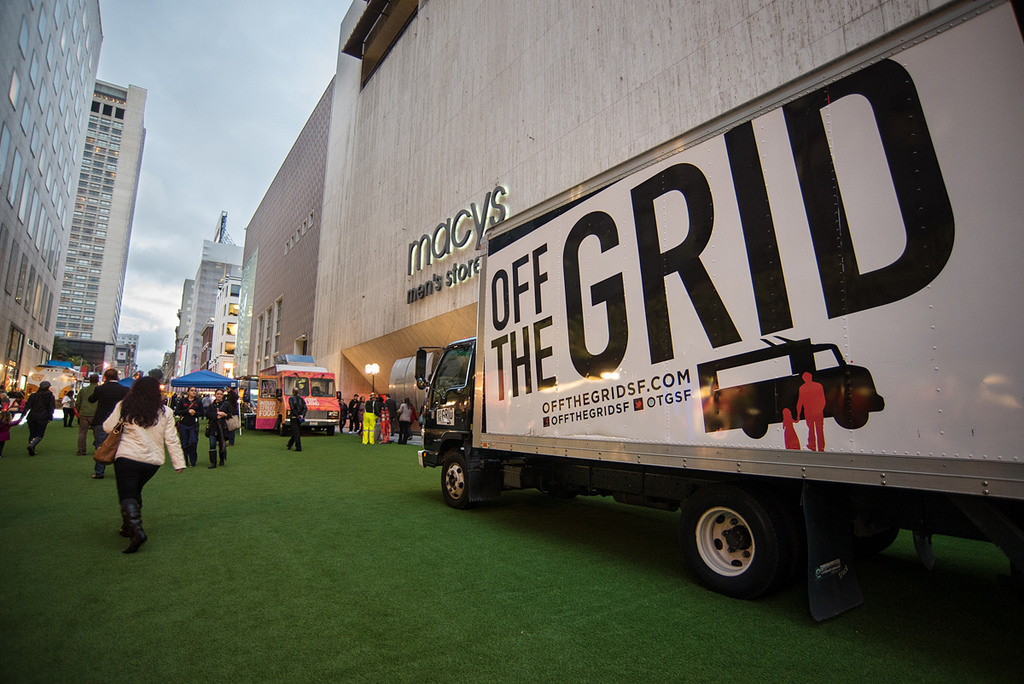
This sparked the idea of making a permanent pedestrian mall. However, the adjacent neighborhood is registering an objection because they want the road to be available to bring traffic to their businesses.
Opinion: This demonstrates a fundamental issue in transportation planing in the United States: for whom is the right-of-way designed? The reason why we have this problem is that Americans tend not to differentiate between roads (which are used to increase mobility and provide a path through a place) and streets (which are used to increase access and provide a path to a place. Instead, we design and construct stroads, which do neither task particularly well, and are dangerous to boot. We know instinctively that we do this incorrectly: just think of the number of times you've complained about people driving too fast through your neighborhood. People drive fast on roads and buy things (and live) on streets. Planners need to get property owners to collaborate on what their right-of-way is intended to achieve, and transportation engineers must design to those purposes. - Getting There: Downtown Spokane businesses suffer in construction zones
Source: Spokesman-Review; August 15, 2016
Summary: Businesses adjacent to construction projects in Spokane depend on revenues from people to travel to their locations. But, when construction occurs, customer visits drop (in one case, by half) imperiling the business. Other businesses are less affected because they have a dedicated customer base. Extending construction hours to reduce the length of time isn't effective because it would cost more and the work is job is hard on the workers.
Opinion:Americans are strongly driven by convenience. If the journey to your door isn't convenient, it just isn't taken. Unless you're an anchor (or "destination") retailer, ease of access is key--and that's exactly what government-maintained right-of-ways are providing. I humbly suggest that, rather than take this story as a tale of woe about construction barriers, please view this as a testimonial as to the effectiveness of the roads all the other summers when construction isn't at your doorstep. Yes, it hurts this year, and help would be beneficial, but remember that the road doubles your sales all other years.
This story has been updated. - Omaha's answer to pothole complaints: a new dirt road
Source: Associated Press; August 16, 2016
Summary: To the chagrin of its residents, the City of Omaha is removing pavement in certain neighborhoods. All cities have a long list of deferred road replacement projects, but Omaha is characterized by extreme sprawl. Making short-term deals in order to encourage development results in these long-term deficiencies.
Opinion: The chickens come home to roost. Of course, the initial developers want to avoid costs in order to make their developments more profitable and avoiding building to City standards is one way to do that. Of course, that means that the neighborhood has a responsibility to maintain the road, but they rarely do because, again, they're trying to avoid paying for what they're using. I hasten to add, though, that we shouldn't dismiss the possibility that the City demands that everyone have a stroad in front of their house rather than a street! Regardless, the costs of periodic repavement is substantial, and many people are satisfied with letting some (read: someone else's) neighborhoods degrade. It's high time that the federal and state governments deny funding for and authority to accept new road construction without demonstrating that they have the funds available to properly maintain their road infrastructure.
What is Sprawl?
I was reading a recent article on The Atlantic Cities entitled High Density Sprawl is Still Sprawl. It got me thinking about what sprawl actually is. While I agree with some of the observations the article makes, I'd prefer to have a definition of sprawl which is less gut-felt.
Sprawl is also not entirely about walkability. I spent my junior high and high school years in the town of Odessa, Washington. Everything in town was within walking distance, what little there was. As an agricultural town, the variety of services available was limited, and no one would say that it was urban. If Odessa were magically transported to the edge of an urbanized area there is little doubt that it would be considered sprawl. However, in its current location it is entirely appropriate and necessary.
Sprawl is also not entirely about suitability. In the article referenced above, the author objects to agricultural activities in a place where he believes water was unavailable or available using inappropriate means. In effect, he is stating that the location is unsuitable for the activity. My observation on this particular example is that the context is missing: what effect does utilizing aquifer water at this location have on other activities, human or not? Perhaps it has a beneficial effect — we have no way of knowing. Nevertheless, suitability cannot be a sole determinant of whether an activity is sprawl, as few would argue that large agricultural tracts immediately adjacent to a high density core and surrounded by low density housing tracts would not be eligible for infill, even if it were of high soil quality. Suitability is an important factor in determining appropriate uses, but it's not determinative.
A high density residential subdivision on the edge of an urban area may be internally walkable, the land may be suitable for that purpose, but its lack of quality relationships with its surroundings gives us pause. (It is likely better, however, than the same number of units spread over a much larger area!) A centrally located large tract agricultural activity may be highly suitable for its particular soil conditions, but it severs the bonds between the core and those it serves. Sprawl, then, is not about the characteristics of the individual use, but about the uses’ context and relationship with surrounding uses.
In attempting to characterize sprawl, we should think in terms of a spectrum – some places are more or less sprawl-like – determined largely on each uses' ability to interact with other uses. A residence may be sprawl in one location and not in another based on its ability to facilitate interaction amongst other residents, commercial and retail areas, and third spaces. Likewise, the presence of a residence alters the degree of sprawl experienced by adjacent parcels.
Sprawl is avoided, then, by ensuring a mix of positively interactive uses. (It is important to note that negative interactions do exist and should be minimized. Zoning was intended to separate incompatible uses; it has been well argued that it has gone too far.) It is easy to see how density would contribute to the number of interactions available to a location, as would walkability. Suitability can be integrated into our understanding of sprawl by including the positive or negative interactions between the use and the natural services provided at the location, and the interactions caused by all externalities.
But why do we even care about that? If both areas function, then what is the issue? Economics is not a gentle mistress. Inefficiencies built into our land-use patterns weigh upon economic development initiatives, and the region’s earning potential suffers. Increasing hostility in our politics indicates that our culture is beginning to devalue the ability to interact civilly with other people, potentially due to a reduction in opportunities to practice interacting civilly with other people face-to-face. One might say we are suffering from a breakdown of positive interactions in several ways, and we should care about these things for both cash and culture.
Just one final thing: let us remember that the correction of sprawl is not an end in itself. Sprawl is merely a way of measuring the net positive interaction of site within its context. It is an abstract concept, created to measure the relative dysfunctionality of a location. It cannot diagnose the cause of the problem, but merely the presence of one. The solution must remain in the hands of those who are disadvantaged by it, and those it will harm in the future.
What it is not
First, let's start with the things that sprawl is not. It is clear that sprawl is not entirely about density. If it were, then sprawl would not need to be a separate concept – we would only speak in terms of density. It's more complicated than that. When the author notes that high residential densities at the edge of an urban region constitutes sprawl, I believe he is mostly correct, but there important details that are missing from the analysis.Sprawl is also not entirely about walkability. I spent my junior high and high school years in the town of Odessa, Washington. Everything in town was within walking distance, what little there was. As an agricultural town, the variety of services available was limited, and no one would say that it was urban. If Odessa were magically transported to the edge of an urbanized area there is little doubt that it would be considered sprawl. However, in its current location it is entirely appropriate and necessary.
Sprawl is also not entirely about suitability. In the article referenced above, the author objects to agricultural activities in a place where he believes water was unavailable or available using inappropriate means. In effect, he is stating that the location is unsuitable for the activity. My observation on this particular example is that the context is missing: what effect does utilizing aquifer water at this location have on other activities, human or not? Perhaps it has a beneficial effect — we have no way of knowing. Nevertheless, suitability cannot be a sole determinant of whether an activity is sprawl, as few would argue that large agricultural tracts immediately adjacent to a high density core and surrounded by low density housing tracts would not be eligible for infill, even if it were of high soil quality. Suitability is an important factor in determining appropriate uses, but it's not determinative.
Interrelationships
Like many other things in planning, it's not merely a single concept which tells us about how the neighborhood works. Yes, the characteristics of sprawl are related to density, walkability, and suitability. However, the interrelationships between various elements of a neighborhood – how it works in a practical sense – determines the health and functionality of the place. If the concept of sprawl is to be useful, it must also contain these interrelationships.A high density residential subdivision on the edge of an urban area may be internally walkable, the land may be suitable for that purpose, but its lack of quality relationships with its surroundings gives us pause. (It is likely better, however, than the same number of units spread over a much larger area!) A centrally located large tract agricultural activity may be highly suitable for its particular soil conditions, but it severs the bonds between the core and those it serves. Sprawl, then, is not about the characteristics of the individual use, but about the uses’ context and relationship with surrounding uses.
In attempting to characterize sprawl, we should think in terms of a spectrum – some places are more or less sprawl-like – determined largely on each uses' ability to interact with other uses. A residence may be sprawl in one location and not in another based on its ability to facilitate interaction amongst other residents, commercial and retail areas, and third spaces. Likewise, the presence of a residence alters the degree of sprawl experienced by adjacent parcels.
Sprawl is avoided, then, by ensuring a mix of positively interactive uses. (It is important to note that negative interactions do exist and should be minimized. Zoning was intended to separate incompatible uses; it has been well argued that it has gone too far.) It is easy to see how density would contribute to the number of interactions available to a location, as would walkability. Suitability can be integrated into our understanding of sprawl by including the positive or negative interactions between the use and the natural services provided at the location, and the interactions caused by all externalities.
The Uses of 'Sprawl'
We here in Spokane have, for a very long time, recognized that the lack of middle income housing in downtown Spokane is a problem. In a way, it's the same problem that we have with large residential subdivisions that lack commercial activities. Both areas exhibit the same weakness; both areas show signs of sprawl.But why do we even care about that? If both areas function, then what is the issue? Economics is not a gentle mistress. Inefficiencies built into our land-use patterns weigh upon economic development initiatives, and the region’s earning potential suffers. Increasing hostility in our politics indicates that our culture is beginning to devalue the ability to interact civilly with other people, potentially due to a reduction in opportunities to practice interacting civilly with other people face-to-face. One might say we are suffering from a breakdown of positive interactions in several ways, and we should care about these things for both cash and culture.
Just one final thing: let us remember that the correction of sprawl is not an end in itself. Sprawl is merely a way of measuring the net positive interaction of site within its context. It is an abstract concept, created to measure the relative dysfunctionality of a location. It cannot diagnose the cause of the problem, but merely the presence of one. The solution must remain in the hands of those who are disadvantaged by it, and those it will harm in the future.
Subscribe to:
Posts (Atom)